Wednesday, April 27, 2011

Being Schooled (study time)

Luce's - Flathorn

Lesson 14: Necessities are anything but bare

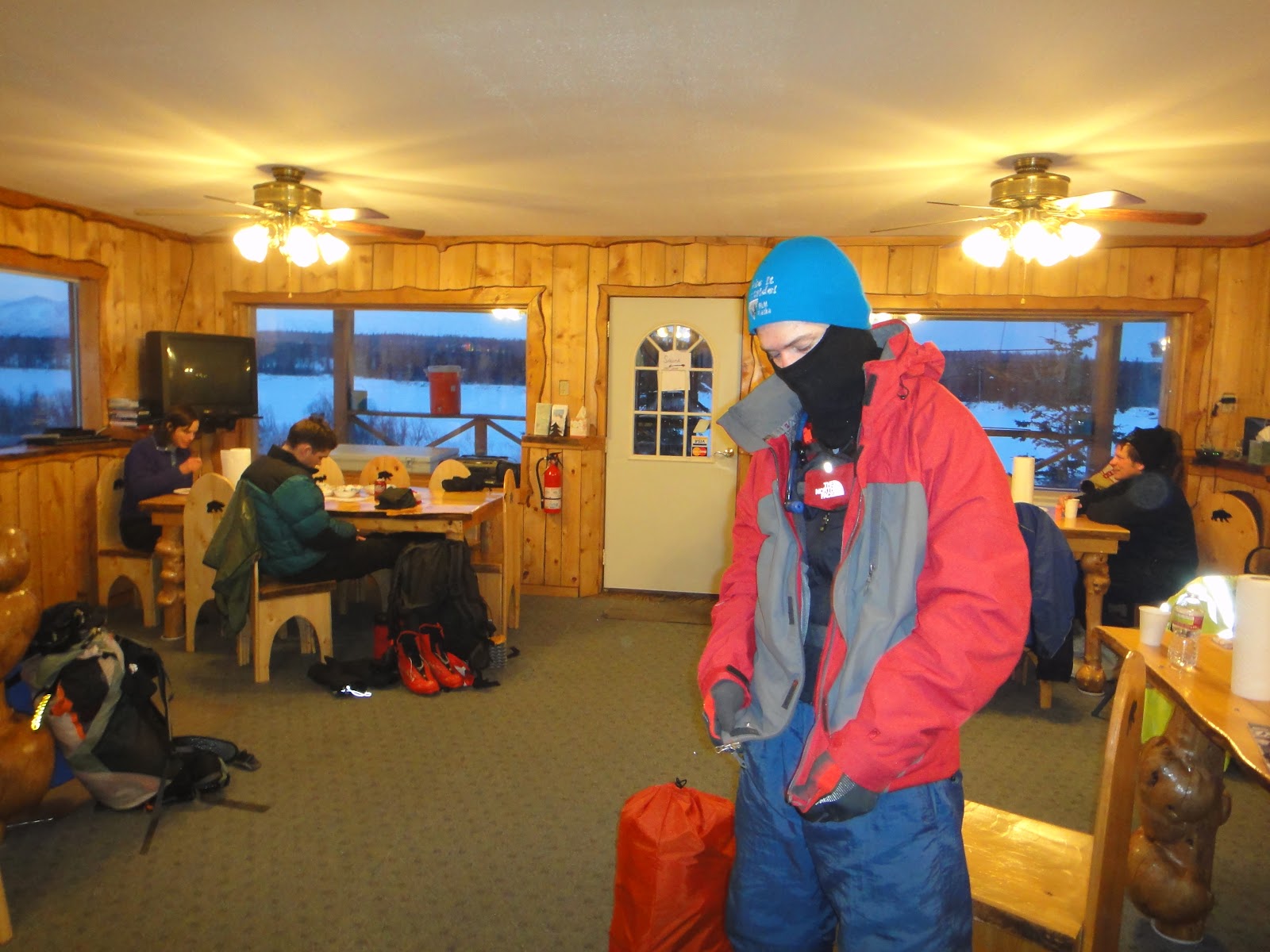
Back at Luce's tired faces filled the room. All seemed to be moving slowly. Day was breaking. The fire was going. I was hungry. Other than during the freezing wind the previous evening, I'd been eating pretty well throughout the race. I'd consumed both of my frozen snickers, eaten through my various gummy candies, all my turkey jerky, even finished off my Hammer Solids. Unlike other races, I never felt even the slightest stomach discomfort. Even right after scarfing down a bunch of food at once, there was no sense of heaviness. I don't know whether from the lack of jostling due to a slower pace or simply another side-effect of the cold, but it seemed my body would process as much food as I could stuff into it. In fact, the one thing I regretted was not eating more during my previous visit to Luce's.

After sorting myself out in the lodge, I was about to order a nice big plate of spaghetti when I saw someone carrying one filled with eggs, sausage and pancakes. It wasn't listed on the white-board, but apparently they had a breakfast special that included all this along with orange juice and a bowl of fruit for only $10! I had a 20 left in my pack so I offered to buy for Hernan as well. Breakfast never tasted so good. It felt as if my digestive system was running on overdrive. I imagined the food converting instantaneously to warmth and energy reviving me as the glycogen-filled blood moved through me. Sitting in the cabin watching the sun rise over the Yetna river mad it easy to let oneself be lulled into a sense of complacency. I could picture myself simply sitting by the window staring at the peaceful white terrain all day.

Shortly, activity in the cabin began picking up. The Iron Dog snowmobile race would be running across the river before heading up to Nome and Luce's was a popular place from which to watch. We decided that we'd better get going before we'd have to share our trail with machines traveling 90mph heading in the opposite direction.

Lesson 15: A day can pass in the blink of an eye

When I headed out of Luce's it was still quite early in the morning, but by the time I would arrive at Alexander Lake it seemed the day was already gone. Sunday was a beautiful day and I retained a sense of it along with a few specific memories. However, it was one of those periods--not uncommon in a long race--when it felt as though I moved past time rather than through it. Hernan and I stuck together for the bulk of this section and talked more than we had over the previous 24 hours. For the most part, our pace was rather leisurely, but the miles seemed to pass rather swiftly.

While we'd managed to get off the Yetna before the main race pack came through, we couldn't avoid the dozens of spectators riding to and fro. For some reason, it seemed that whenever we found a descent line in the snow, a rider would come through and turn it to mush. The river was a mile wide in parts and I couldn't figure out why they insisted on sharing the tiny section of firm snow on which we were trying to travel. I spent a lot of time staring down, looking for solid bike tracks. It was at this time that I noticed certain tire patterns appeared as a series of words. I tried to make out what each of the 4 letters sequences was supposed to spell: "SPAK", "PLUT", "DOFT", etc. None of it made any sense. Eventually, rather slowly, I realized that these couldn't be actual words as the pattern didn't repeat. There were far too many unique "words" for one rotation of a tire. It was clear my eyes were playing tricks on me, but I kept looking as I found it somewhat entertaining.

My mind in something of a trance-like state, we were standing at the base of the Wall of Death in no time. Making it up The Wall turned out to be much more of a challenge than going down had been the day before. About half way up, I had to dig my gloves into the snow to keep from sliding backwards. However, once at the top and moving again, Hernan and I were through the woods without incident finding ourselves quickly back on the Dismal Swamp. We picked up the pace a bit knowing that Flathorn was approaching. A little ways before the end of the swamp, Hernan said he needed to make a pit stop. I decided to keep going as I was now feeling some drive to get to the final section and have this race done. I pushed on.

The next few miles were nearly the first were I actually recall being "in a hurry". I decided that I wanted to finish this race on my own. This meant either putting a gap between myself and Hernan or let him go on ahead of me. His need for an off trail excursion gave helped make the decision for me. I walked fast and shuffled along the next couple miles then out onto the lake. I was focused and moving well, carefully picking my line in the snow in front of my feet. Before I knew it, I was approaching the end of the lake. I stopped and looked to my left realizing that the entrance to the checkpoint was behind me. I'm not sure how I missed a marked turn out in the middle of a large expanse of frozen lake. I guess that's what happens when you become lax in your studies.

Post-holing across the snow, I cursed at myself. Here I was approaching the final miles, forgetting one of the most first lessons I'd learned in doing any long-distance events. Don't finish your race before its done!

Thursday, April 21, 2011

Being Schooled (night classes)

Alexander - Luce's

Lesson 12: The incentive of other's demise

The checkpoint at Alexander Lake was like a triage tent. When I opened the door to the cabin the first thing that struck me was the quiet. The single room was filled with people, but most were either laying in beds or sitting in stunned silence. It was required to have your sleeping bag checked here to assure you hadn't swapped it out before the race. The volunteer working here spoke in hushed tones as she checked bags and checked up on sleeping racers. There wasn't much in terms of aid here, but I did get some hot soup and sat down by the fire after removing my layers. I looked around the room at all the folks in various states of disrepair and realized that I was actually feeling quite good.

While I sat one runner had started to head out and then returned to the cabin after collapsing  in the snow. The checkpoint woman helped him into the last remaining bunk. Not long after that Jamshid entered the cabin and started complaining about his vision. He didn't have any goggles and was worried he might have damaged his eyes in the cold. I was feeling enormously fortunate as I sucked down a second cup of soup. I decided not to waste too much time here. Seeing all these people and then learning there was another tent with even more people sleeping provided me motivation to get a move on.

I'm not an extraordinarily competitive person when it comes to these type of events, but I am aware that it is supposed to be a race. Nonetheless, I always experience a slight twinge of guilt at how other's ill fate can inspire me to positive feelings about my own situation. I wouldn't say it was anything as base as smugness. Though some of the people I'd seen were the same ones I'd noticed going out "hard" in the early miles, running up slopes. It's not that I felt an air of superiority because I am always well aware how much luck is involved in keeping oneself healthy during an event such as this. Besides, I had certainly made my share of mistakes along the course any one of which could have ended my race curled up in a cabin. I think that it mainly serves as a reaffirmation. Seeing others in a bad state reminds me that I'm doing relatively well. So, no matter how low I might feel, I should just get on with the race. 

Lesson 13: There's cold and then there's...

I hitched up my sled and set my sights back towards Luce's as I headed onto the dragging snow. Within the first mile I saw Beat, Jill and then Danni all heading towards the checkpoint looking well and in seemingly good spirits. This was one of the shortest sections, but it was the dead of night and I wasn't moving especially fast. I could feel the fatigue growing within me. I knew that the dawn would eventually revive me, but I had a few more hours of darkness until then. I was also aware that the time just before sunrise was generally the coldest of the day. Being sleepy was not making me feel any warmer.

I saw a light moving up ahead. I figured it was probably Hernan so I hustled to catch up. I don't know that the running gait moved me any faster, but it did seem to warm me up a bit. It seemed strange to run for warmth rather than for time. However, it turned out to be a very useful technique. I added an addition to something I'd learned earlier in the race. Sometimes walking is faster than running, but sometimes you run anyway. Apart from building up a bit of heat in my body, it also helped keep me awake. My mind had started to drift and the monotony of slowly trudging through the snow made it worse.

I caught up to Hernan and asked if he minded some company. Feeling a bit tired himself, he welcomed it. I don't know that we said more than a few words to one another along this section, but it was nice to have someone else to share the cold, dark hours. We took turns leading through, seeking out the narrow lines of packed snow created by bike tires. Whether following or leading, having someone with me on the trail helped me maintain lucidity. It did nothing, however, to keep me warm. I was pretty much in full kit short of digging out my giant down jacket. However, even with 3 layers on my hands, I could still feel the chill coming through to my fingers.

We descended back onto the river just as the sky began to lighten. With only a couple miles remaining to the checkpoint, we picked up the pace. It was unbelievably cold so moving faster was a welcome change on multiple counts. By the time we arrived, I was more than a little ready for a break. I didn't check the thermometer on the way in, but by the time we would leave at 8am it would still read -10. Given its more sheltered location and the fact that the air had warmed significantly by then, the temperature on course the previous night was easily 20-below.


Saturday, April 09, 2011

Being Schooled (slow learner)

Luce's - Alexander

Lesson 10: These are no mere checkpoints

I checked into the cabin, stripped layers off to remove my pack and sat at the large wooden table. Word was that it was at least 10 below zero without even calculating in the 20-mph wind chill. I was a bit shook up. Wandering in those conditions with only the minimal light of my small backup headlamp and my face exposed to the elements was just plain dumb. I tried fiddling with my main headlamp, but was feeling a bit light-headed. I'd actually done pretty well with calories throughout the day, having dipped into my stash a few times and eaten my fill at Flathorn. However, anything that slowed, let alone stopped movement in the last couple hours had not been an option in my mind. I was obviously near empty. Someone handed me a cupcake or something sweet and I ate it in one bite. Feeling somewhat revived, I gathered up my clothes and headed over to the fire.

They call the small cabins along the course simply "checkpoints", but that does little to describe the atmosphere within. Luce's is a working lodge that serves mainly ice-fishermen and snowmobilers. Coming in from that frozen world outside, the term "refuge" came immediately to mind. Warm and inviting, I could see why someone might want to spend a nice winter week in this place. While the previous stop seemed like a traditional aid-station, this place was an actual business so food was only available for purchase. Most people seemed to be opting for the big plate of spaghetti, but I wasn't sure if it would sit well given how I felt at the time. I ordered a large hot chocolate and a basket of fries then sat down and tried to warm up while I waited for them to be prepared.

Hernan had arrived and we sat near the stove together chatting. I was having some difficulty getting warm, but the hot food and drink were helping. I'd grabbed a few things from my sled and was changing my socks while trying to dry out my feet and shoes. The many trips off-trail had gathered snow on them. While the dry snow mainly just gathered on top, as soon as I came into the checkpoint it melted wetting my feet. I'd retrieved a few items from my sled and after changing socks I swapped the batteries in my big headlamp which solved the problem. Apparently, I'd drained them before the race. I began slowing putting myself back together, orienting myself towards a mindset for heading back out.


Making quick time in and out of the checkpoints seemed not only impractical, but undesirable. I wanted to make sure to minimize gear mistakes going forward. I also wanted to shore up my confidence. Spending time in the cabins was simply a part of this race. Jamshid, whom had run this race numerous times past, was here and informed me there was a sauna available to racers. Coming up on an hour since my arrival, the potential for an even greater time suck was a dangerous proposition. However, I came up with a plan to get myself out the door. Just as I was putting it into action, my friends arrived. They too looked a little worse for wear. With their food orders arriving as I was heading out, I knew I'd be seeing them all again.

I geared completely up, face mask, headlamp and all. Carrying only my outer-shell mittens in my hands, I headed out the door. Instead of going right for my sled, I took a left and headed into the sauna. Five minutes: that was enough time to completely warm my core without starting a sweat. I headed over to my sled and attached it as quickly as possible. I could feel the heat trapped in my layers and was determined to keep moving in order to retain as much of it as possible. The mental image of myself as a little insulated stove helped warm my spirits. I headed onto the river with an attitude much improved over the one with which I had arrived.


Lesson 11: There's something called "noglide"

The wind had died down, but it was no less cold. There were three more miles along the river and then some gradual climbing up to the swamp that leads to Alexander Lake. I'd seen a few bikers heading home on my way into Luce's, but the bulk of the returners passed by on this section. I was glad for the 4"-wide, packed-down tracks they were leaving in the snow. The night is always slower moving in an ultra, but I felt like I was downright dragging. Apparently, when snow is very dry and very cold, there is no "glide" to it. I'd learned this from a skier at Luce's who was explaining why most of them had already dropped from the race. Without the ability to glide across the snow, they were relegated to walking with skis on their feet. For me, it simply felt as if the "pig" attached to my hips was digging in its heels.

I've said it a dozen times before: I love being out on the trails at night. Susitna after dark was nothing short of magical. With a bright lamp now on my head, I could also look around and enjoy the environment. The sky was a bit hazy with a soft glow of light to the south hinting at the far-off existence of civilization. As much as I wanted to take in every bit of this, I also longed to be at the next checkpoint which, beyond the halfway mark. It's always with a small amount of regret that I employ the dissociative mind-tricks necessary to make it through certain parts of these long events. However, I know that to stay completely in the present, perceiving the full passage of time, would likely spoil my mood and taint the entire experience. As I often do, I went "inside myself" and let the hours disappear only occasionally mindful of myself and my surroundings.

Despite slow moving, the twelve miles to Alexander passed relatively quickly. Yet, I retained a definite feeling for the atmosphere as well as memories of distinct moments along the path. The lead runner passed by not long after coming onto the swamp. A few more went by within the next hour. The only other people I saw along this section were the row of snowmobiles parked at the spot where the route takes a sharp left. They pointed the proper direction and let me know it was around 4 miles to the checkpoint. That would be over an hour at my pace, but I was feeling good. Along the way, one of the snowmobiles came flying by. Apparently, a runner hit some difficulties and was bivy-ed alongside the trail waiting for an evac.

The final stretch found me in good spirits. As I approached the cabin, I had a renewed sense of confidence. Over half the course was done and I still felt strong even if my pace was slow. Watching the guy end his race on the back of the snowmobile, I felt bad for him. However, the sight also made me aware of how well I was doing. This was a serious race where dropping required an airplane ride out and I was still on my feet, moving well, heading into mile 53.

Wednesday, April 06, 2011

Being Schooled (serious lessons)

Flathorn - Luce's
Lesson 6: There's always someone

A couple of miles outside the first checkpoint we dropped onto an offshoot of Flathorn Lake. While trying to figure out just what the heck the ice fishermen were doing, another sled-puller came up alongside me. We chatted. His name was Hernan. He was from Argentina, but living in Florida. I guess coming up to Alaska for a winter race from California wasn't so far fetched. It occurred to me he was only the second person with whom I had shared more than a few words during the race so far. It's not that people were less friendly, or so focused and competitive, it just seemed that you tend to talk less in the cold. I'd later learn that when it gets very cold, you don't talk at all.

Hernan and I would end up crossing back and forth as well as spending quite a bit of time together during the race. It's not uncommon, in long races, that I end up finding someone whose pace is close enough to mine to act as motivation, companionship or simply a life-line moving along in the distance ahead or behind me. Hernan moved on ahead just before we reached the checkpoint and I stopped to take some pictures of the lawn gnomes they'd set up in the snow. This was the intersection where the 50K race headed back to the start (as would we in another day or so). I shuffled over to the checkpoint, my mind abuzz with all the new information I'd been trying to stuff into it during these first 21 miles. I felt as if I was barely learning just how much I still had to learn.

I saw Hernan at the top of the hill as I dropped my sled which encouraged me to hustle on up, forgetting the change of socks I'd been reminding myself to grab. I'd been told to plan on spending a bit of time at the checkpoints warming up, changing clothes, and getting one's self together. Forgetting to grab essentials from my duffel was a pretty big rookie move. I'll give myself the excuse that the cutoff to the first aid station seemed a bit tight for a race that allowed 48 hours to finish. Arriving in just under 6 hours, I only had an hour buffer going in and would spend half an hour getting out.


Changing socks back down by my sled posed challenging and Hernan headed off on the next section ahead of me. It gave me a chance to say hello to Beat, Jill and Danni as they came in together. Perhaps, in retrospect, finding a more experienced person to glom onto would have been the wiser move, but I prefer to make my mistakes and learn on my own so I trotted out across the lake to catch up with my new friend. I set my mind on Luce's, the next checkpoint, as I wanted to be at that 40+ mile point. There's something comforting about having an ultra-marathon distance under the feet. These long events always involve some amount of pain, but after a certain point it seems the pain stops getting worse.


Lesson 7: Sometimes walking is faster, even on flat ground

Across the lake, through some woods and it was onto Dismal Swamp where I finally caught up to Hernan. It's interesting to look at the Susitna course via "satellite view" on Google Maps because most of it is under water during the warmer months. Given how much of the area is covered in forest, I suppose it makes sense that frozen lakes, rivers and swamps would be the most obvious pathways along which to set trail in winter. This particular swamp didn't seem nearly as bad as its name would imply, but I'd heard that in past races it's been beset with heavy wind or frozen fog. In our case, it was just long, barren and slow. About the only features here were some scraggly, dead-looking brush and a view of Denali that could just be made out far in the distance.


Hernan and I shuffled along silently, exchanging positions from time to time in order to take turns leading a weaving pattern along the snow in search of the best line. This constant search for a path of packed down snow was a trend that would be followed for much of the race. It's amazing what a difference the slightest change in snow consistency can make on one's effort and pace. I'm not sure the source of the mental imagery, but it was here that I first began to think of the gear sitting in my sled as simply "the pig." Though I think "boat anchor" might have painted a better image. I was running, or so I felt. I was making running-like motions, but could scarcely keep a 17 minute per mile pace on a trail as flat as a sidewalk.

About halfway across the swamp a couple whom I'd seen in the cabin caught up and trailed along behind us. When they shuffled past, I decided to stick behind them jokingly asking, "is drafting allowed?" A short while later they decided the extra effort was being wasted and dropped to a walk. I figured they knew what they were doing and followed suite. The wisdom of this move became immediately evident as walking felt significantly easier.

I thought to imagine myself in a mountain race power hiking up a steep slope. My pace picked up. Suddenly, I found myself moving along the snow at a good clip. It felt solid. It felt good. I glanced down at my GPS and saw that I was approaching 15 minute miles. The first thing that popped into my head was simply, "what manner of place is this where walking is faster than running on flat ground?" After giving it a bit deeper thought I realized what was happening. Whilst "running" I was exerting more pressure with each step. Just enough, in fact, to break through the top crust of hard, frozen snow. Walking, even at a good pace, kept me moving along this surface. Pondering this strange new discovery, I eventually came to another realization. I had left behind the group in which I'd been travelling. I was on my own.


Lesson 8: There are measures of silence

As I moved off the swamp and through a final section of rolling, mogul-ridden woods, I decided some alone time was warranted. I kept up my pace and played the little mind-game of remaining out of eyesight from those behind me. At the end of the woods is a short, but steep downhill quaintly called "Wall of Death". Like the Dismal Swamp, its name seemed misleading especially since it led onto the broad expanse of the Susitna river. I'd been told that the going along the river would be easier especially as the evening temps dropped and the surface hardened up. I was looking forward to it. Twilight was setting in and shuffling along the frozen river with no one in sight, I felt beset by solitude on all sides.

I often seek out these solitary moments during ultras when the silence of my surroundings helps induce a similar inner state. My mind can best be described as a rather noisy place. When not directed towards some specific task, my thoughts tend to be distracted, harried, even erratic. The busy world in which we live does little to quell this constant mental dialog. I like to think that running helps me deal with the trials of modern life, reduces stress by providing time to organize and analyze my thoughts. And during my weekly training runs, it often does. But, these grand adventures serve more as escape than solution. Stripped to the bare necessities of eating, drinking and staying warm, life becomes both simple and frightening. Yet, I find a certain sense of calm in the singular focus on continual motion.

Cold, dry air slows the speed of sound, the silence further amplified by the starkness of the landscape. My mind wanders. but there's a certain clarity to it. The vast quiet of the space and the constant forward movement lend a sense of direction and control reflected by a singular voice within my head. I can almost hear it speaking aloud in my head. It's a level of lucidity I achieve only at rare moments when all the background noise has faded away.


Lesson 9: It doesn't matter how good your gear if you don't use it

My little reverie ends abruptly when the two lead bikers come passing through. Less than 8-1/2 hours into my race and they're already on the homestretch, yet still looking like they're just out for a leisurely ride. It makes me painfully aware of how much further I have to go. I also notice that the sun is in the midst of its slow descent and the temperature is beginning to drop. It would have been a good time to take stock and prepare for the coming nightfall. I knew that I was headed towards a big swing left at a spot named "Scary Tree" (though its actually devoid of any such tree). From there it's a straight shot and 8 miles to the next checkpoint at Luce's Lodge. I fixed my mind on that goal. I decided to wait until after the turn to regroup. This was a mistake.

Winter days may be shorter up north, but they seem to fade with a certain reluctance as dusk lingers into dark. I could tell I was loosing light, but didn't feel any urgency to dig out my headlamp. It was starting to get cold and I occupied myself with the various options for covering my face with the fleece buff. Eventually, I grabbed my jacket from the sled, but passed again on retrieving the light not wanting to make a full stop. Perhaps I was under the illusion that I could make it to the checkpoint in time. It wasn't until I wandered off path into deeper snow that I finally came to my senses. I stopped, zipped my jacket up and began searching through my disorganized duffel.

I'd bought a fancy new headlamp for Susitna. It was much brighter than I needed for a snow-covered race, but specifically designed for extreme conditions. It was also more complicated with a remote battery pack, adjustable beam and a variety of settings. It also didn't work. After some frustration getting it opened, I checked that the batteries were in correctly. I tried turning them around. I fiddled with it in various ways. Finally, I cursed myself for not double checking it right before the race, shoved it in my pocket and grabbed my small backup lamp. I was starting to feel a chill in my body and there was a growing headwind. I needed to get moving.

Unlike heat, there isn't much one can do to adapt the human body for the cold. It really come down to having the proper gear and using it properly. My small headlamp was dim and insufficient. The wind picked up. In my frustration over the headlamp, I'd failed to retrieve either my face mask or my goggles which had been packed for this exact situation. I doggedly marched on. Pulling the buff further in front of my face, I wrapped the headlamp around the hood of my jacket to keep it snug and set my gaze straight down towards the snow to block the wind. Meandering in the poor visibility, I kept wandering off the firm line into deep snow. This did little to help my situation. I told myself that frustration and rough weather didn't mix.

Steeling a glance forward, I could see lights in the distance. I continued on, hopefully. Forging into a bitterly cold wind, I felt I was finally getting a taste of real Alaskan weather. I also felt a small question tugging at the back of my mind. My stubbornness often gets me through these long events, would the same land me in trouble now that the situations was more serious? As I approached the lights, I realized they were not from the checkpoint, but two other races stopped along the trail. I checked my GPS and estimated about 2 miles to go. I let the them know as I passed. Encouraged that I was "close" I continued pushing forward.

Heading into a 20-mph freezing wind, 2 miles would take more than 40 minutes. After finally reaching the checkpoint and dragging my sled up the hill to the lodge, I stood there for a moment berating myself over poor preparation and decision making. The buff was completely frozen around my face and I could now feel the cold air biting at my skin. How stupid to leave it exposed in the much harsher conditions out on the river.

The checkpoint volunteer who recorded my number told me, "get inside, you can come back and retrieve stuff from your sled once you warm up."

I obeyed.


Thursday, March 31, 2011

Being Schooled (learning to learn)

Start - Flathorn

Lesson 3: You just can't tell the weather in Alaska. In fact, you can't tell it anything!

A week before the race, forecasts called for a little snow leading up to and then clearing with temps in the low-20s on race day. This sounded about perfect to me even with the usual 10-degree drop or so on the remote sections of the course at night. Then, at the pre-race meeting, there was talk of epic snowfall and we watched the white stuff coming down all day Friday in Anchorage. We heard moans and groans from bikers at the local REI as they contemplated how much pushing would be required. We debated the need for snowshoes. Finally, word at the start was that much of the course hadn't seen any snow at all. The forecast was for clear skies the whole way which meant sunny days and frigid nights. I had no point of reference for any of this. I'd just experienced my first sub-zero temps, the sun was shining, I was freezing, and wearing more layers of clothing than I'd ever thrown on my body. Heading out, the weather and trail conditions, occupied my mind, but the course had plenty new experiences in store for me ahead.

The course goes roughly thus: along a road, through the woods, across a swamp, to a lake, another swamp, along a couple rivers and then a final swamp to the turnaround where you do it in reverse, with some variation at the end. Of course, its all frozen solid and covered in snow. But, as I learned, snow comes in seemingly endless varieties. While I lack the experience to discern subtle differences, it was easy enough to tell that the quality of snow was going to be a major factor in this race. The deep, fluffy stuff in the initial miles were wrecking havoc with bikers as they futilely attempted to ride only to slide off and have to push before trying again. The narrow trail alongside the road became quite crowded making it also difficult for the skiers who needed a bit more space. Those of us on foot faired a somewhat better and I passed quite a few if only to keep myself moving. Still, it was no simple stroll and I would have preferred a more even effort at the start of the race. It did, however, manage to warm me up and I was able to remove my gore-tex jacket top layer.


After about 3 miles alongside Ayreshire Rd., we cut across it and onto a different road. Wide and packed-down, it was better for everyone. The bikes took off immediately, disappearing down the road, for the most part, not to be seen again until heading in the opposite direction. The skiers pulled away more slowly, but they at least  looked to be skiing now as opposed to walking with planks on their feet. While, it was clear that the weather and conditions have different implications for each chosen mode of transport, the impact to those of us on foot seemed to be less dramatic overall. Hard pack or deep snow, sunny skies or brutal storm, I realized that my pace on this course was going to fall within a certain general range: slow. I decided to "run" along this road just because I could. I took it easy trying to conserve energy, but still felt I was moving at a better pace than my GPS seemed to let on. Of course, I had no idea at the time that this would constitute my sole sub-14 minute mile of the entire race. As we turned off the road and into the woods, I knew I had a lot to learn.


Lesson 4: The sled does what the sled wants.

The next section of the course consisted of rolling hills and seemingly endless moguls. The moguls would become a major source of frustration. They are created by snowmobiles, but, then, so are the trails. It was the very definition of a mixed blessing. It's strange how things that hurt in the early part of an ultra will dissipate as the hours drag on. I commonly experience certain foot and leg twinges early on. In this race, my hips would be added to that equation as the sled tugged and pulled at them in new and uncomfortable ways. I remember my gluteus feeling sore and numb in the initial miles. Later in the race I don't recall thinking about my butt at all. Perhaps because there were bigger things occupying my mind. The challenge of the moguls helped take my mind off some of these early pains.

Here's the problem with moguls. As I crested a mogul, the sled would still be dragging up the slope. Then as I headed down the other side, picking up a little speed, it would tug the sled up and over the peak. So the sled would get a nice tug as it headed down the mogul just as I started up the next mogul. The momentum of the sled picking up speed coming down as I slow down heading up would thrust forward the PVC poles attached at my sides. Momentarily free from the weight of the sled (or even slightly assisted by it's nudging my hips forward), I would get a couple of good steps in near the top of the mogul just as the sled would lose its momentum on the upslope and begin sliding back. My legs pushing uphill, 40lbs of sled pulling downhill in the opposite direction, the poles would yank back just as my hips pushed forward on the waste belt. It all became rather annoying.

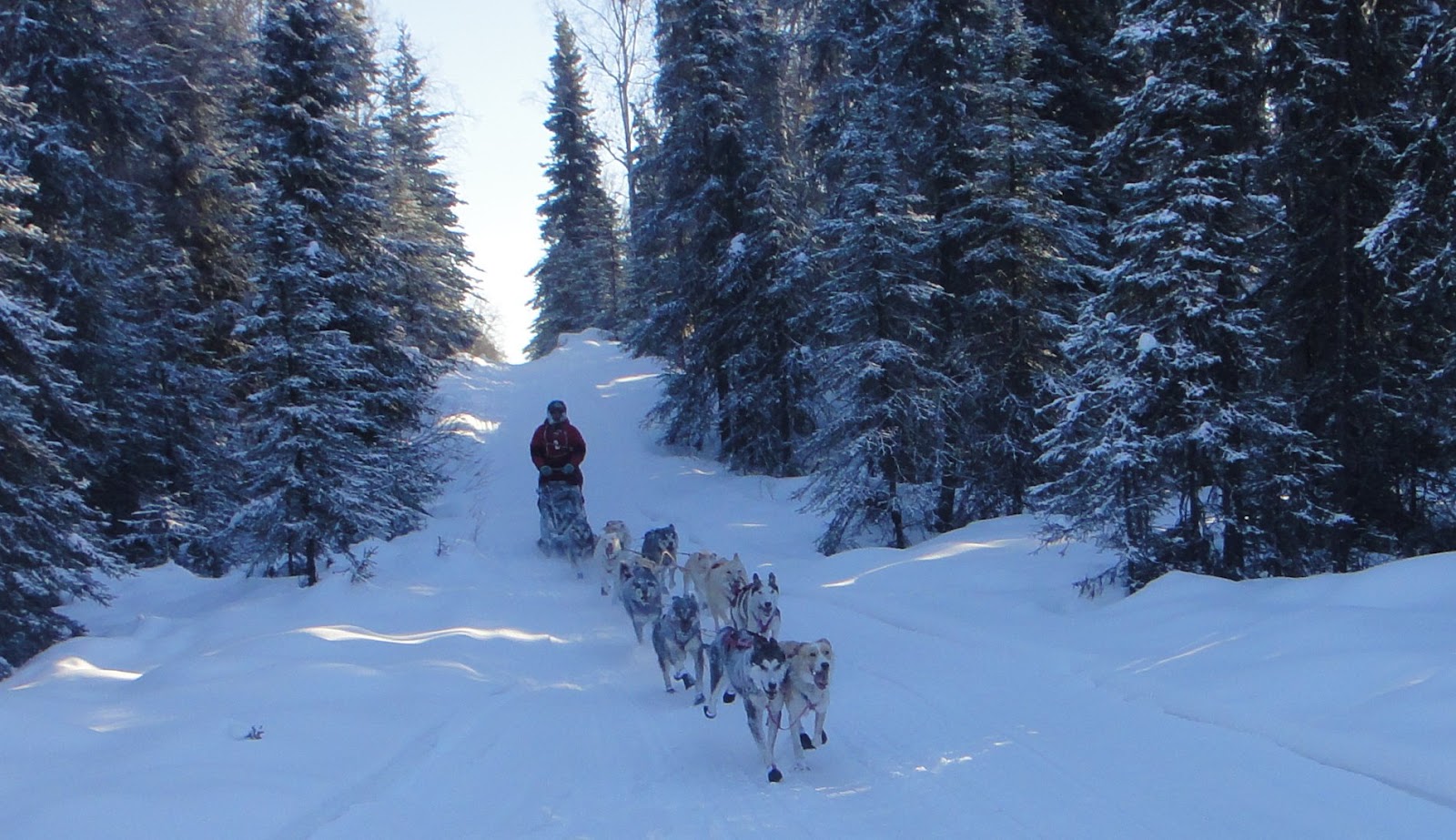
Basically, that's all a very long-winded way of saying that the system had too much play. I eventually took to grabbing onto the poles as I headed over moguls in order to minimize the impact. I also used this technique heading down longer hills, though in that case the issue had more to do with lateral flexion and the sled's tendency to want to slide down alongside rather than behind me. I learned to try and head where I thought the sled would want to go rather than where I might have desired. I was starting to understand why many of the more experienced racers had sleds attached directly to their back with stiff poles. With some padding and a good dampening system the minor pressure on the back could more than be made up for by increased control. I spent a lot of time contemplating better sled designs. I also fantasized a bit about riding the sled and being towed by a pack of dogs like the mushers who were out practicing along this section.


Lesson 5: Venting

The information on the Susitna 100 race website warns not only of the potential for extreme cold, but for wide variations in temperature as well. I don't know what the reading might have been mid-day with the sun reflecting off the snow, but by the time I reached the famous Nome Sign, I was feeling warm. Dealing with the cold is mainly a matter of having and using the right gear. Having no true field test, I had concerns a plenty about my gear, but a bigger concern was my propensity to sweat. Nothing is more dangerous in a race like this than working up a good sweat and then super-cooling that moisture close to your skin. I'm told its the fast path to hypothermia.


I'd been given both the advice to keep cool enough not to sweat as well as to just continue sweating in order to stay warm. Seemingly contrary, they are actually both excellent pieces of advice, but, once again, my lack of experience simply added them as two more items on my long list of things to figure out on the go. The one piece of advice I did take to heart was about layering. Following is the complete list of clothing that I wore for most of the race. (warning: blatant brand pimping to follow): smartwool toe socks (liners), smartwool socks (over), Brooks Adrenaline ASR shoes, Outdoor Research Gore-tex gaitors, Brooks Windbreif boxers, Brooks Infiniti tights, Brooks Wind Pants, Brooks Equilibrium baselayer, Brooks Run vest, Ultimate Direction Wasp hydration pack, Brooks HVAC 1/2-zip, Brooks microfleece, fleece Buff, Brooks fleece beenie. Seirus Thermalux liner gloves, Outdoor Research Meteor Mitts fleece liners. And that's just what I wore during the day! I had my Outdoor Research Mentor jacket strapped to my duffel with the Meteor Mitts, a Seirus facemask and a Mountain Hardware windstopper fleece hat and numerous changes of socks all inside. There was still more gear in the bag, but most went unused during the race. It seems like a long list written out like that, but being able to modify layers on the fly turned out to be critical.


Venting is a concept with which I'm familiar. In California it's almost never as cold as it looks outside. In fact, the times when it appears rain is eminent, can often be the warmest. So I have experience knowing when to expose my wrists, hands, neck, ears or head to cool myself down if I've overdressed for conditions. In Alaska, I was glad to discover the same principles to apply, only--like most things--to a greater extent. It was almost as if I could feel the heat draining from my body through the exposed parts of my skin. My first line of defense was, as usual, my wrists. Pulling up my fleece to expose the mid-weight layer was often enough. Next I would flip open the top of my fleece mittens to expose my liner gloves. After that I would expose a bit of ear beneath my hat or unzip my outer layer to let some air onto my neck. In the middle of the day it was warm enough, that I actually had my fleece around my waste, mittens tucked into my belt, shirt zipped down and face exposed. Of course, that didn't last long. 

I was reminded that it was still below freezing outside when my drink tube became exposed. I had followed Jill's advice to wear my pack below some layers, but it only took short contact with the elements to turn the water in the tube to ice.  Luckily, I had also followed her advice not to cover the tube with insulation allowing me to see where it had froze. With some careful chewing, I was able to break up the ice and get water flowing again. I think there are, at least, a few more lessons in there somewhere. However, for the time being, I was satisfied with the knowledge that I seemed to be figuring things out. 

Wednesday, March 30, 2011

Being Schooled (first lessons)

All races, especially the very long ones, present learning opportunities. A race like Susitna is more akin to a post-graduate exam. With the added complication that you're expected to apply what you've learned immediately because not only finishing, but possibly even surviving may depend on it. With my limited time in the snow and a complete lack of experience with extreme cold temperatures, I have never felt less prepared before a race. Certainly, I did my homework and I was perhaps more comfortable with the distance than many, but in terms of first-hand knowledge of how my body and my gear would handle the conditions, it was going to be on-the-fly lessons of trial and (hopefully not too much) error.

Pre-race:


Lesson 1: -10 is cold; -17 even colder

If I felt unprepared heading into this race, the emotion reached its pinnacle shortly before the start. Driving towards Point McKenzie the temperature gauge in the rear-view mirror of our rental car crept continuously lower. It hovered around 10-below as we parked the truck, jumped out and immediately headed up to the store for some breakfast. This wasn't simply a little colder than anything I had experienced before, it was significant. I had run in 75F temps just the previous weekend! I'm certain my nervousness sat visibly on my face as we ate. I was quite glad when it was time to head back to the truck for final preparations. Movement and action were a good distraction from the torment of my overactive imagination.

It didn't seem possible, but down at the truck it felt even colder than before. Attempting to sort myself out was proving most difficult. 9am seemed to be accelerating towards us. I skipped the idea of trying to wax my sled as I struggled with my gaiters having almost forgotten them until the last moment. Everything seemed slightly harder in the cold and I could feel a tiny panic creeping into my psyche as I watched people heading to the start line. I managed to pull it together, focusing on level breathing as I snapped into my sled and started up the hill. Strangely, I noticed that the hyperventilated pattern of my breaths actually made me feel better, even a tad warmer. Perhaps panic serves an added purpose in the extreme cold.

Much later in the race, I would hear a couple of locals talking about the weather at the start. Upon learning that it had been around -17, one of them said, "I thought so. I knew it was colder than -10. I could feel that stinging in my cheeks." Apparently, Alaskans learn to discern the subtle variations of what I would simply call "really damn cold!"


Lesson 2: Misery loves company, but fear demands it


I've stated before how I often enjoy being alone late in these sorts of events, living in my own mental world, finding random sources of motivation to move me towards that final destination. At the end of this race, I'd be in a whole other universe, but at the start it was a different story. Seeing the rows of racers--first bikes, then skiers and, finally, those of us on foot--gave me my first bit of calm. There's something reassuring in knowing that at least a handful or two of other people are willing to undertake a challenge most would consider somewhere between inane and insane. Even though I knew many of those around me had significantly more experience with these conditions, it stood as a visual demonstration that it could be done.

I relaxed and tried to take in the scene. Other than a few aggressive looking bikers up front, everyone seemed fairly casual. In a race that may take some almost two full days to complete, the start is far too early a place to begin to panic. There was time and enough for that to come. I took pictures, watched the front bikes take off followed by a jumble of various racers behind them. I was enjoying it so much that I had to remind myself at one point that I was supposed to be a part of this spectacle. I fell in about midway into the "runners" (at this point anyways) and took a look around as we headed uphill. I marveled at what an amazing place this was to be. To think, we hadn't even gone anywhere yet!


Monday, March 28, 2011

A Parable....of sorts


The young initiate, returning from his journey, arrived in the remote village from which he'd left. Dropping his rucksack, he sat down before his master.]

Master:
   How were your travels? Did you see all you wanted to see? Was it as everything you had hoped?
Initiate:
   Indeed.
Master: 
   Then tell me of your long walk, what you learned and your plans for the future.
Initiate:
   Well, I first traveled to the jungle to view the very heart of nature itself. It is a warm and bountiful place, teaming with all manner of varied life. Some so seemingly alien and bizarre as to make one wonder in awe at the uniqueness of our own. Pondering the path we've ascended through the millennia from that swamp can provide many a lesson.
   Next, I crossed the desert. Hot and dry, it seemed both desolate and uninhabitable. Yet, there too I found life. Hiding under every unturned stone, clinging to bits of moisture, thriving in the shadows, it has adapted to a world beneath the unforgiving sun. I learned that life can endure even the harshest of conditions. Study there too, would be filled with enlightened discovery.
   I then climbed the mountains to survey the full array of the land. What a marvel our planet is when seen from on high. From grassy planes, to deep forests to sand-swept beaches reaching into the sea, one could fill multiple lifetimes with lessons studying the variety it has to offer.
   Finally, I headed North into the tundra. It was cold and bleak, a vast, quiet land most inhospitable to life. I discovered that survival there is tenuous, but possible. The feeling of being alone in such a harsh environment can run so deep that often one's own mind poses as much danger as the threat of freezing.
Master:
  And, what of the cities?
Initiate:
   Ah, the cities! They are truly a wonder to behold, the height of human achievement. Such comfort and security have they made that one can certainly understand the allure. Despite the ignorance and poverty that exists in the world, what people have built when they come together gives such hope. And, yet, I cannot escape the conclusion that most would be better off were they to spent more time visiting the jungles, deserts and mountains of the world, heeding the lessons those wild places have to teach.
Master:
   Very true. But why not the tundra?
Initiate:
   I do not think most people are prepared to survive there.
Master:
   Because it is too cold?
Initiate:
   No, because it is too lonely. I think they would be frightened by the sound of their own thoughts.
Master:
   So this is where you wish to establish your school?

[Surprised as always at the astuteness of his master, the initiated paused before answering for he had only just come to this conclusion himself]
Initiate:
   Yes...I will place it deep within the frozen north. The desire to reach such a desolate place may attract very few students, but the journey itself--with one's inner voice as sole companion--will be all the lesson they require. For travel across that land offers learning with every step.


Susitna?


I realize this page is supposed to be occupied by a race report rather than the above little story that will undoubtedly have some of my friends uttering "wtf?" I wrote the above in the days following the Susitna 100 as way to entertain myself as I tried to organize my thoughts and searched for a theme to my report. I hit on the idea of a series of lessons. Beyond simply being one of the longest and most arduous physical challenges I've yet undertaken, the race was also one of the greatest learning experiences I've had during such an adventure.


Ultimately all learning is self-learning. If we fail to relate and apply a lesson to our own lives then I'm not sure it can really be called a lesson learned.  With 8 lessons and less than 40 miles described so far, I think I'm learning something equally important about my writing. While I've still managed to finish every race I've begun, I'm close to posting a DNF on (yet another) race report. I believe the problem lies in my approach. If I've learned anything about finishing 100-milers it's not to try and take on the whole thing in a go. Breaking it into shorter section, at least mentally, makes covering such full distance much more manageable. It also provides points for reflection and adjustment. 


One of the reason for taking so long to finish race reports is that I tend to want it all complete, edited and perfected before I share; I'm a bit compulsive that way. However, that's not how the races are run. The other reason is that I like to savor the telling, reliving the journey as I write. Clearly, these two goals, taken together, can work against ever getting the thing done. So, I'm going to meter out this report over the coming weeks starting with the parts I've already written. Either lesson by lesson or section by section, posting it in parts will, I think, work as incentive. Once I hit that "publish" button I'll have to face myself standing there, in the middle of the page, out on some frozen river, waiting to finish.

Tuesday, February 22, 2011

Please wait a moment...

36 hours and 56 minutes. That's quite a lot of time for which to make a complete accounting. While I attempt to wrap my brain around everything that I went through during that time, you can read Jill's initial recap or peruse the race results and ponder what sort of event has initial finishers completing it on bicycles, Saturday evening, a bit more than 11 hours and the final one crossing on skis, Monday morning, nearly 47 hours after leaving the start.

Friday, February 18, 2011

Over the cliff


Last night was the pre-race meeting and gear check. If there was any residual question that Susitna requires a significant more preparation than your standard 100-miler, they were answered there. Giving a credit card to cover potential evacuation costs, showing your sleeping bag was rated for at least 20-below, having your 3000 emergency calories examined and then weighing your minimal gear to assure it was over 15-lbs, went well beyond the standard "sign your name and pick up your bib" requirement of most pre-race check-ins.

Gear check
Once the laborious registration process was complete, it was time for the RD presentation. A self-described pessimist, his deliver of the weather forecast was somewhat ominous. Apparently, a storm was moving in and expected to dump a large load of snow that night and all day Friday. His expectations of what this meant for the race were presented quite dryly in his initial slide.


  While most people took this omen with a grain of salt, the weather turned out to live up to expectations.

At least 4" dropped overnight and it snowed throughout the day

I had initially thought the race began on Friday. Luckily, this was wrong and, in retrospect, it couldn't have been otherwise. Friday before Susitna is reserved for all the necessary last-minute activities including shopping for important necessities such as better gaiters, vacillating back and forth on whether to bring the snowshoes or not (they're coming), experiencing all of the varying shades and subtleties of the stages of panic, and, most important of all, making all of the final preparations to your sled and gear set-up. This last, took most of the afternoon.

In the end, our sleds could not possibly have looked more distinct from one another. Each one expressing, perhaps not so much our individual personalities, but certainly our approach to preparing for this race.

Beat's Sled: The Craftsman
Beat experimented with a number of different designs for his sled coming up with his own unique ideas on what constituted a good approach and building it himself by hand. His final version was tweaked based on his training. It rides a bit high, but he assures that it is both stable and low friction. It certainly demonstrates the care he put into both the conception and construction.
Bike handlebars and kids skiis - who'd of thought?

Jill's Sled: The Pro
Jill's sled is not only race proven, but has actually won this race and still holds the course record in the foot division. It's only fitting that the one of us with the most experience both with racing in Alaska and with Susitna  specifically should be trailing this beauty. While this is Jill's first time tackling the race on foot, none would ever guess based on the slick cart that will be following her every move.
A sled built for speed

Danni's Sled: Psychedelic Snow Blower
While the design is one of the most common, consisting of the same kids toboggan and ropes-through-PVC poles that I will be utilizing, Danni put her own unique touch on this classic. A trip to the craft store and some creative use of Velcro took it from basic to beautiful. 1968 may have been the summer of love, but for Danni's sled, 2011 is the winter of love.
She called it The Clown design: it's certainly the most fun!

My Sled: Homebrew
While I purchased the standard kit from the race, I put the pieces together myself and experimented with a few different options. Yes its raw, sure it looks thrown together and held up by plastic and bungee cords, but, like a first experimental batch of beer, it will get the job done. I think.
Duffel, straps, some plastic, what more do you need?
Pimpin' that Brooks logo!

After admiring our handiwork, we took our loads out for test spins along the street.

Beat with a big grin
Danni strikes a pose
Jill going for broke

Finally, a last parting shot of all four of us. Next photo I take will be at the start.
Here we go!