I love words, playing with sentence structures, teasing semantic overtones, reveling in the subtle shades of meaning from choosing one word over another. I can spend hours obsessing about the phrasing of a single sentence. My more serious posts to this blog can sometimes take days to complete. I've even one that's months old still siting in the queue, unposted, unfinished. No doubt, I've been accused of exhibiting a certain pedantry.
Numbers as well. With numbers my tendencies tend towards a sort of compulsiveness. I've been logging my runs since around 2000. Before that I wasn't consistent (or confident) enough in my running to track it because once its recorded, it's later reviewed then manipulated, analyzed and, ultimately, judged. Time, distance, pace, elevation, calories. Splits, averages, fastest, longest, most, best...worst.
The first few years I maintained written logbooks, but eventually moved to an electronic one. I was always meticulous about recording my runs. If I didn't have my log with me on a trip, I would record the time and distance on some random scrap of paper. Miles would be calculated from maps or estimated (roughly) in their absence. Online mapping software was my best friend. Before a run I'd use it to explore possible routes and alternatives; afterward, I'd retrace the precise path I had taken. I was actually fairly resistant about getting a Garmin for some time. I always said it was just one more thing over which to obsess. But, secretly, I think I really enjoyed the process of adding miles up on the map--mentally re-living the run along the way.
Eventually, I gave in to the GPS. After all, I am a gadget lover as well. Simplicity of recording meant more time for post-run analysis. With programs like SportsTracks, I could review trends: daily, weekly, monthly. I could even generate custom reports; my obsessive nature delighting in the minutiae. With such tools, I can now figure out the difference between my average pace on Wednesday afternoon versus Thursday evening runs over the course of a given year! What more could I as for?
I, similarly, had an initial aversion to using a heart rate monitor (HRM for the initiated). If I already spent way too much time checking the watch for my current pace, distance and accumulated time, I would likely become downright rediculous wirh yet another number to track while out on my training runs. Then there's the whole bio-feedback angle where the very act of worrying about my HR can make it go up. But, alas, I committed to follow the Maffetone equation and keep my heart from beating more than 145 times every 60 seconds during my base building phase. There was pretty much no way to avoid adding yet another electronic device to this normally simple sport, further feeding my obsession with a constant stream of numbers.
So, I've been monitoring my heart rate, trying to keep it below 145 bpm while maintaining a consistent (but, hopefully, increasing) pace. At least in these initial weeks, my pace and average HR vary quite a bit based on a number of factors that I can't always identify. Basically there are good days and bad. I've been looking for a way to compare workouts so I can look for a general trend. My idea was to simply multiply HR in beats per minute (bpm) by pace in minutes per mile (mpm) to come up with the metric of beats per mile. I could then compare the results of this function from one run to another as a sort of index.
The problem with this function is that HR doesn't necessarily rise linearly with pace. So, for example, if my average HR at 10-mpm is 140 and at 9-mpm its 150 then the I get values of 1400 and 1350, respectively. Further, the reality is even more dramatic as my HR seems to go up more slowly as my speed increases, at least to a certain point. After that I, need to work much harder for increases in pace. However, this point, the functional minimum (or the point where the first derivative equals zero for the mathematically inclined), is well above the 145 recommended max HR. I could conclude that I should just try to run as close to 145-bpm as possible in order to optimize this function within the limit. However, this is not only difficult to acheive in practice, but probably goes against the spirit of Maffetone. The idea is to keep all your running below a certain effort level, not to target a particular average while pushing the pace.
I suppose I could just try to minimize my total heart beats over a week, but then my distance is pretty variable so perhaps I could just look at the average per mile. However, even here, weeks with longer runs will tend to skew the data as my HR is higher for a given pace late in a very long run and, therefore, not comparible to the measure added up from a few shorter runs. There are also runs with my wife where I go at her pace so my HR will tend to be much lower overal than if I were just running at my own pace within the zone. No, the only thing to I can do is compare workouts where my HR is at near the same average and see if pace is increasing over the weeks (or conversely compare runs where the pace is similar and see if HR is decreasing). There's no need for my beats per mile metric if HR (or pace) is kept constant.
Oh well, at least I can have some new useless facts with which to waste time. My heart beat 98,560 times while running the last week. Fascinating. This does bring me to one last thought which is the concept of "lifetime heartbeats". As runners, we are often confronted by sedentary people who offer up some dubious criticism of our sport generally as a rationalization for their own lack of fitness. Usually its something about ruining our knees, being hit by cars or eaten by wild animals. However, chief among these absurd claims has to be the assertion that "we only get a certain number of heart beats in our lifetime." The idea being that we runners are going to die sooner because we are using up our heart beats at a faster rate.
Let's enter the couch potato's fantasy land and grant this claim at face value. The average male human resting heart rate is around 70-bpm. Mine is about 48. Let's assume that when not sleeping our fictional sloth manages a modicum of exertion--getting up to go to the fridge, walking to the car, moving between cubicle and elevator, etc.--and manages a weekly average of 75-bpm (we'll put mine at 55). A week has 24*7=168 hours. On a good week (when not racing a 100 miler), I will get in 11 or so hours of running. Let's say that I work pretty hard and have an average HR of 150-bpm for my runs. That would be 11*60*150=99,000 beats while running. The rest of the week would total 157*60*55=518,100 beats for a total of 617,100 beats for the week. Now, our sedantary man in that same week will have accumulated a total of 168*60*75=756,000 beats. Even on a week where I ran a 30hr 100-miler with an average HR of 140 (no way I could keep that high in a 100), my total would still be just over 700K.
Now, tell me, who is going to use up their heart faster?
After all this data gathering and post-data gathering analysis, there is really only one inexorable conclusion. I am, quite likely, borderline OCD about certain things (I can hear you laughing, honey, but its a big border, OK?) The only cure I've found is to lose myself in a very long run on a remote trail somewhere with the GPS serving only its most vital function of reminding me that I do, eventually, need to return home (and letting me know just which way that might be if I need it).
Wednesday, January 28, 2009


Monday, January 26, 2009
Does this race make my ass look fat?
The Fremont Fat Ass 50K has been a great way to start the season the past two years and I still wanted to be a part of it this year even if I wasn't prepared for the full distance. With my long bike rides, I felt my aerobic condition was fine. The question was more about how much pounding my calf could put up with. My goal was to just run for 2-3 hours, perhaps 15 miles or so. I would still be aiming to keep my heart rate under 145bpm so I would start with the back-of-the-pack runners. It would be nice to go at a more casual pace and socialize after pushing it last year to finish under 5 hours.
I started out running along with Drs. Cynthia and David, two PhDs who work in the patent law industry. Having had to deal with software patents from various fronts in my job, we had some very interesting discussions. About half way to Coyote Hills we came upon Jim Winne. Jim has an arrythmia condition and was having some heart rate issues this day. He said it was common for him and he would be fine so long as he kept his HR below a certain level. He was doing so with frequent walk breaks. He said he was probably going to turn around early and asked us to let Catra know if we saw her.
Since I was taking it easy anyway, I decided to just stick with Jim. If he was going to turn around early then it would be good incentive for me to do the same. Besides, it's always interesting spending time with some of the people who have been around this sport much longer than I have. Despite the slow pace, we were approaching the entrance to Coyote Hills before we knew it. I told Jim that this was pretty much the last chance to cut it short and he said he was going to go ahead and finish the whole thing. I decided I'd better stick with him for safety sake. That's my story and I'm sticking to it! OK, the truth is I am just too pig-headed to stop. If Jim was going to finish and my calf was feeling fine, then how could I turn back early?
As we made our way to the water stop at the Dairy Glen area we caught up with Linda McFadden and Barbara Elia who had started early. I ran with Linda for a bit at Coyote Two Moons last year and Barb, well, you can't really run ultras in the Bay Area for long and not know who Barbara is. I've seen her at so many races that I've joked that maybe she just runs from the end of one to the start of the next. She has been running ultras since I was in high school and has probably run more miles than just about anyone on the planet. I ended up sticking with Barb for the remainder of the race. I've talked with Barara before, but this was the first chance I have had to spend extended time hearing about all of her amazing experiences.
I finished the race in 6:37 (nearly two hours slower than last year) and my average HR was 144. Ron Duncan, whom I'd met two years ago at this race, came in first and was kind enough to go out and buy pizza and beer for everyone behind him. No that is a tradition that I think this race should adopt! My calf felt fine the entire race and the only pain is from being out of conditioning. After running with my wife for a little under 10 miles more on Sunday evening, I still feel fine. For some reason, my thighs are actually the most sore and there is a pain in my left glute that will need some work this week. I guess that is sort of par for the course. Besides, I know I can be a pain in the ass to my wife with my running obsession, it's only fair that I should end up with one at the end of one of her runs.
I started out running along with Drs. Cynthia and David, two PhDs who work in the patent law industry. Having had to deal with software patents from various fronts in my job, we had some very interesting discussions. About half way to Coyote Hills we came upon Jim Winne. Jim has an arrythmia condition and was having some heart rate issues this day. He said it was common for him and he would be fine so long as he kept his HR below a certain level. He was doing so with frequent walk breaks. He said he was probably going to turn around early and asked us to let Catra know if we saw her.
Since I was taking it easy anyway, I decided to just stick with Jim. If he was going to turn around early then it would be good incentive for me to do the same. Besides, it's always interesting spending time with some of the people who have been around this sport much longer than I have. Despite the slow pace, we were approaching the entrance to Coyote Hills before we knew it. I told Jim that this was pretty much the last chance to cut it short and he said he was going to go ahead and finish the whole thing. I decided I'd better stick with him for safety sake. That's my story and I'm sticking to it! OK, the truth is I am just too pig-headed to stop. If Jim was going to finish and my calf was feeling fine, then how could I turn back early?
As we made our way to the water stop at the Dairy Glen area we caught up with Linda McFadden and Barbara Elia who had started early. I ran with Linda for a bit at Coyote Two Moons last year and Barb, well, you can't really run ultras in the Bay Area for long and not know who Barbara is. I've seen her at so many races that I've joked that maybe she just runs from the end of one to the start of the next. She has been running ultras since I was in high school and has probably run more miles than just about anyone on the planet. I ended up sticking with Barb for the remainder of the race. I've talked with Barara before, but this was the first chance I have had to spend extended time hearing about all of her amazing experiences.
I finished the race in 6:37 (nearly two hours slower than last year) and my average HR was 144. Ron Duncan, whom I'd met two years ago at this race, came in first and was kind enough to go out and buy pizza and beer for everyone behind him. No that is a tradition that I think this race should adopt! My calf felt fine the entire race and the only pain is from being out of conditioning. After running with my wife for a little under 10 miles more on Sunday evening, I still feel fine. For some reason, my thighs are actually the most sore and there is a pain in my left glute that will need some work this week. I guess that is sort of par for the course. Besides, I know I can be a pain in the ass to my wife with my running obsession, it's only fair that I should end up with one at the end of one of her runs.
Wednesday, January 21, 2009
Happy Returns
I am happy to say that I just completed my first week of consistent running since my injury. I ran a total of 22 miles from Monday to Monday all at a very easy pace. The longest outing was just an hour and a half, but I have done bike rides of 3-1/2 hours and 4 hours the past two weekends to keep up my endurance. I've also continued the exercises given to me by my physical therapist and I have had no pain in the calf at all. This next weekend I am planning to attempt my first long run. I may join the Fremont Fat Ass 50K, but don't expect to run the entire distance. Maybe something in the 2-3 hour range. I will either do a bike ride on Sunday or a shorter run with my wife depending on Saturday's results.
The following weekend is the PCTR Race Series Awards Ceremony in Walnut Creek. While I didn't win any awards (I only ran one race in the series anyway), I'm going to attend because it promises to be fun. I am going to ride my bike to the ceremony and back. The ride I did this past weekend was a test of the route. I started too late and had to jump on BART in Pleasanton after 57 miles because it was getting dark and the last thing I wanted was to try to ride on Niles Canyon Rd. after dusk. Based on this ride, I expect the entire 72 mile trip to take about 5 hours. I will leave from Fremont BART around 6am and then head back out after the ceremony at noon. I've plotted the route I plan to take on Google Maps.
So far, this doesn't really stand as a training plan, but if I get through these next few weeks I will feel confident enough to put something more formal together. Stay tuned. I'm back. Hopefully, I'll have something more interesting to write about soon.
The following weekend is the PCTR Race Series Awards Ceremony in Walnut Creek. While I didn't win any awards (I only ran one race in the series anyway), I'm going to attend because it promises to be fun. I am going to ride my bike to the ceremony and back. The ride I did this past weekend was a test of the route. I started too late and had to jump on BART in Pleasanton after 57 miles because it was getting dark and the last thing I wanted was to try to ride on Niles Canyon Rd. after dusk. Based on this ride, I expect the entire 72 mile trip to take about 5 hours. I will leave from Fremont BART around 6am and then head back out after the ceremony at noon. I've plotted the route I plan to take on Google Maps.
So far, this doesn't really stand as a training plan, but if I get through these next few weeks I will feel confident enough to put something more formal together. Stay tuned. I'm back. Hopefully, I'll have something more interesting to write about soon.
Friday, January 16, 2009
Phasing into races
After successfully completing two very easy 3 mile runs, I am ready to cautiously declare myself as having returned to running. The real question is how things will progress from here. I'm hoping that my 3-1/2 hour bike ride last weekend is a sign that my endurance is in reasonable condition. My runs have been at a VERY slow pace, like 10+ mpm on flat terrain. However, this actually fits with my original plans. My goal for the early part of this year was to execute a real base building phase which I have never really done in a formal manner. I planned to use the Maffetone approach which has me keeping my maximum HR at 145bpm. To assist with this, I have changed the default display on my Garmin to display heartrate in place of pace while running. Of course, since it still displays time and distance, I can obviously do the calculation in my head. However, it should cut down on my tendency to constantly monitor my pace and to focus more on heartrate.
I have a semblance of a race schedule set up for the first part of the season. However, already, two races have are off. We cancelled our trip to Disneyworld after me being sidelined by my injury and my wife's training going south after a November illness. The next target for her is Big Sur which is supposed to be beautiful. I am still in Coyote Two Moons and am remaining hopeful that my progress will allow me to join the fun an luncacy of that race again. With an average pace of 3mph, it really is more like a long hike where I run the downhills. The only other possible race before then is Sequoia which I will treat as a training run. It is pretty tentative at this point as my son has a potential playoff basketball game that night and we also have a weding invite for the same day. Will play that one by ear.
After Coyote Two Moons, I plan to finally run the Diablo 50m since it doesn't fall on my wife/mother/nephew/mother-in-law's birthday weekend. Those two races should get my endurance up. I then want to have a "big" month of May before tapering for States in June. I didn't get into Miwok this year (no 3-peat for me) so I will look for another race in early May. Options include the following:
After States, I really have not firmed up any plans. I have some ideas of other 100s I'd like to do, but will probably be limited to those that do not fill early. I will likely return to Javelina again and consider making a streak of it. However, I really can't look that far ahead right now. I am most focused on the immediate comeback. I will do my first run of an hour or longer this weekend. I will also probably do another long bike ride to keep the endurance up. It really is day by day at this point.
I have a semblance of a race schedule set up for the first part of the season. However, already, two races have are off. We cancelled our trip to Disneyworld after me being sidelined by my injury and my wife's training going south after a November illness. The next target for her is Big Sur which is supposed to be beautiful. I am still in Coyote Two Moons and am remaining hopeful that my progress will allow me to join the fun an luncacy of that race again. With an average pace of 3mph, it really is more like a long hike where I run the downhills. The only other possible race before then is Sequoia which I will treat as a training run. It is pretty tentative at this point as my son has a potential playoff basketball game that night and we also have a weding invite for the same day. Will play that one by ear.
After Coyote Two Moons, I plan to finally run the Diablo 50m since it doesn't fall on my wife/mother/nephew/mother-in-law's birthday weekend. Those two races should get my endurance up. I then want to have a "big" month of May before tapering for States in June. I didn't get into Miwok this year (no 3-peat for me) so I will look for another race in early May. Options include the following:
- 5/2 - Sycamore Canyon 50K or Wild Wild West 50K
- 5/9 - Quicksilver 50m or PCT 50m
- 5/16 - Bishop High Sierra 100K or 50m
After States, I really have not firmed up any plans. I have some ideas of other 100s I'd like to do, but will probably be limited to those that do not fill early. I will likely return to Javelina again and consider making a streak of it. However, I really can't look that far ahead right now. I am most focused on the immediate comeback. I will do my first run of an hour or longer this weekend. I will also probably do another long bike ride to keep the endurance up. It really is day by day at this point.
Tuesday, January 06, 2009
"...moving fast and efficiently, breathing calmly, monitoring himself so as not to get into oxygen debt as he fought gravity to the top. His sure feet knew the trail so well, every rock and root, twist and slant, that he felt he could close his eyes. But he didn't. Every path, no matter how well known, contains the unexpected."
----
The path is in sight.
After many fits and starts, entire pain-free weeks followed disparagingly by short test runs that ended in calf-seizing setbacks, I finally went to the doctor. He referred me to the very knowledgeable physical therapists at Elite Sports Physical Therapy. During my first consultation my therapist, Jacon, confirmed what I had suspected, but also explained something that had remained a mystery to me. It certainly appeared to be a fairly severe calf strain. However, the reason I have been having so much trouble recovering from it is that I have been fighting against the body's natural healing process.
When the body heals a wound, scar tissue develops around the site to help promote healing. It was explained to me that it works somewhat like a cast holding the injured fibers together. The problem is that scar tissue is inflexible and doesn't necessarily align with the movement of the muscle. This means that as you try to come back from an injury you are often working against the scar tissue (especially if you are trying a little sooner than you should). Not only does this explain the occurrence of re-injury, it also explains why I was experiencing the "cramping" feeling whenever it happened. My calf muscles were basically pulling against the scar tissue that were holding the injury in place.
My rehabilitation involved some ultrasound and soft tissue work to break up and help re-shape the scar tissue along with exercises that increasingly load the muscles to both strengthen the supporting areas and help align everything with proper movement. It started with seated toe-ups against pressure from my hands, but quickly progressed to body-weight versions. Combined with this has been a number of single-leg balancing exercises performed on spongy blogs that reduce impact, but also really work all the stabilizers on the outside of the legs. The one-legged jumps were the final test and I could really feel it in the legs as well as the hips. I am going to incorporate all of these into my normal routine going forward.
So, the end result of all of this was that yesterday I got on the treadmill. I ran at an easy 10 minute-mile pace while Jacon watched my gait. He showed me a couple of stretches to help with some tightness that might be causing a slight outward rolling on the injured side. I went less than a mile, but felt ZERO tightness in my calf or pain around the inujured area. This was a first as when I did the previous tests on my own I always felt tightness at the start (foolishly convincing myself that it would go away upon warm-up). The only thing I did feel was a in my shins, but this was most likely due to the 50-mile bike ride I did on Sunday. In the end he gave me the go ahead to start running.
I did 3 miles last night at a very easy pace with my wife. No tightness. No Pain. No calf seizing up. Everything felt good. I'll probably do a couple more easy runs this week and then do about 6 or so this weekend to see how it holds together approaching the one hour mark. I'm going to keep it on the flats for now, but returning to the trails in the near term no longer seems a fantasy.
I will most likely head up Mission Peak once I feel strong enough for the hills. Being as it is so familiar to me, it has stood most clearly in my mind when I imagine being back running on the trails.
----
"Kim was, as always, utterly happy while running, in accord with nature, in harmony with the universe, in touch with the truth that was in him, full of love for all creatures, even the lowliest insect."
- The Holy Man by Susan Trott
----
The path is in sight.
After many fits and starts, entire pain-free weeks followed disparagingly by short test runs that ended in calf-seizing setbacks, I finally went to the doctor. He referred me to the very knowledgeable physical therapists at Elite Sports Physical Therapy. During my first consultation my therapist, Jacon, confirmed what I had suspected, but also explained something that had remained a mystery to me. It certainly appeared to be a fairly severe calf strain. However, the reason I have been having so much trouble recovering from it is that I have been fighting against the body's natural healing process.
When the body heals a wound, scar tissue develops around the site to help promote healing. It was explained to me that it works somewhat like a cast holding the injured fibers together. The problem is that scar tissue is inflexible and doesn't necessarily align with the movement of the muscle. This means that as you try to come back from an injury you are often working against the scar tissue (especially if you are trying a little sooner than you should). Not only does this explain the occurrence of re-injury, it also explains why I was experiencing the "cramping" feeling whenever it happened. My calf muscles were basically pulling against the scar tissue that were holding the injury in place.
My rehabilitation involved some ultrasound and soft tissue work to break up and help re-shape the scar tissue along with exercises that increasingly load the muscles to both strengthen the supporting areas and help align everything with proper movement. It started with seated toe-ups against pressure from my hands, but quickly progressed to body-weight versions. Combined with this has been a number of single-leg balancing exercises performed on spongy blogs that reduce impact, but also really work all the stabilizers on the outside of the legs. The one-legged jumps were the final test and I could really feel it in the legs as well as the hips. I am going to incorporate all of these into my normal routine going forward.
So, the end result of all of this was that yesterday I got on the treadmill. I ran at an easy 10 minute-mile pace while Jacon watched my gait. He showed me a couple of stretches to help with some tightness that might be causing a slight outward rolling on the injured side. I went less than a mile, but felt ZERO tightness in my calf or pain around the inujured area. This was a first as when I did the previous tests on my own I always felt tightness at the start (foolishly convincing myself that it would go away upon warm-up). The only thing I did feel was a in my shins, but this was most likely due to the 50-mile bike ride I did on Sunday. In the end he gave me the go ahead to start running.
I did 3 miles last night at a very easy pace with my wife. No tightness. No Pain. No calf seizing up. Everything felt good. I'll probably do a couple more easy runs this week and then do about 6 or so this weekend to see how it holds together approaching the one hour mark. I'm going to keep it on the flats for now, but returning to the trails in the near term no longer seems a fantasy.
I will most likely head up Mission Peak once I feel strong enough for the hills. Being as it is so familiar to me, it has stood most clearly in my mind when I imagine being back running on the trails.
----
"Kim was, as always, utterly happy while running, in accord with nature, in harmony with the universe, in touch with the truth that was in him, full of love for all creatures, even the lowliest insect."
- The Holy Man by Susan Trott
Monday, December 08, 2008
Not yet
I've not written lately due to my injury. That sounds a bit silly since its my leg and not my fingers that are the problem. However, my compulsive nature mixed with my tendency towards hypochondria means that any writing I do whilst laid up, runs the risk of coming off like one gigantic whine fest. Consider yourself warned.
Somewhere during those final miles at Javelina I made a sacrafice without realizing it. Apparently, my left calf was the offering that the running gods demanded in exchange for meeting my time goal. It has now been a full three weeks and I still cannot run on it. That isn't to say that I've not made the attempt. Then again, perhaps I'd be closer to fully healed had I done otherwise.
After a little research, I am pretty sure it isn't a stress fracture since the pain is on the side and back of the calf. If it were a fracture, it would have to be the more rare fibular type rather than the much more common fracture of the tibia. I'm pretty sure it is just a calf strain. However, that "just" is a bit of misnomer as these strains can come in varying degrees of severity, as I learned. A "grade 2" strain can take 5-8 weeks. I don't think it could be a "grade 3" as that seems like it would entail a much more intense level of pain than anything I have been experiencing.
There wasn't any traumatic event during the race which caused this. However, I do believe that there may have been such a few days after. My calves were extremely tight after Javelina, especially the left. I had promised myself to take a full week of recovery before attempting to run. Stupid is as stupid does and about mid-week after the race my legs were starting to feel a bit better so I tried a little test. It seemed harmless at the time. I was just going to run a little bit down the hallway at work. A few steps into it and that characteristic "pop" was exactly what I felt in the back of my leg. This was followed immediately by two other sensations. First, a much more intense pain in the calf similar to a severe muscle cramp. Second, the immediate, sinking feeling of what an idiot I was. From that point on any "toeing off" action allowed me to revisit these two direct results of my inability to follow even my own rest plan.
It responded fairly well to ice and even better to message. By week three after the race, I started on the stationary bike which felt pretty good. I did a little walking on the treadmill and even some very easy jogging. It was definitely feeling better and I could even hustle up stairs without felling like I was going to send it into spasms of pain. I had planned to wait until the following weekend to test it on a real run. That runner's amnesia I've mentioned before may be useful for getting through the pain of an ultramarathon, not so much for recovering from an injury.
Thursday night I was feeling so good I went out for an easy 3-miler. Everything felt tight during the first mile or so, but it loosened up after that. The calf still felt "tentative" at best. After two and a half miles, I had concluded that it was only "OK" and that I would give it a couple of more days of full rest before trying another run. Then, about 1/4 mile from home, it completely seized up again. I believe my evaluation of "Steve, you fucking idiot" was actually audible this time. The only upside was that, afterwords, I did discover a few spots to massage on the side of my calf that, while very painful, definitely loosen things up.
More ice, more rest, more massage. This past weekend was spent back on the stationary bike. I did an hour and 45 minutes on Sunday night. I never thought that the treadmill ever look so inviting. As a reminder to myself, I am copying the rules for "when you can return to normal activity" from the sports medicine section of about.com below.
Somewhere during those final miles at Javelina I made a sacrafice without realizing it. Apparently, my left calf was the offering that the running gods demanded in exchange for meeting my time goal. It has now been a full three weeks and I still cannot run on it. That isn't to say that I've not made the attempt. Then again, perhaps I'd be closer to fully healed had I done otherwise.
After a little research, I am pretty sure it isn't a stress fracture since the pain is on the side and back of the calf. If it were a fracture, it would have to be the more rare fibular type rather than the much more common fracture of the tibia. I'm pretty sure it is just a calf strain. However, that "just" is a bit of misnomer as these strains can come in varying degrees of severity, as I learned. A "grade 2" strain can take 5-8 weeks. I don't think it could be a "grade 3" as that seems like it would entail a much more intense level of pain than anything I have been experiencing.
There wasn't any traumatic event during the race which caused this. However, I do believe that there may have been such a few days after. My calves were extremely tight after Javelina, especially the left. I had promised myself to take a full week of recovery before attempting to run. Stupid is as stupid does and about mid-week after the race my legs were starting to feel a bit better so I tried a little test. It seemed harmless at the time. I was just going to run a little bit down the hallway at work. A few steps into it and that characteristic "pop" was exactly what I felt in the back of my leg. This was followed immediately by two other sensations. First, a much more intense pain in the calf similar to a severe muscle cramp. Second, the immediate, sinking feeling of what an idiot I was. From that point on any "toeing off" action allowed me to revisit these two direct results of my inability to follow even my own rest plan.
It responded fairly well to ice and even better to message. By week three after the race, I started on the stationary bike which felt pretty good. I did a little walking on the treadmill and even some very easy jogging. It was definitely feeling better and I could even hustle up stairs without felling like I was going to send it into spasms of pain. I had planned to wait until the following weekend to test it on a real run. That runner's amnesia I've mentioned before may be useful for getting through the pain of an ultramarathon, not so much for recovering from an injury.
Thursday night I was feeling so good I went out for an easy 3-miler. Everything felt tight during the first mile or so, but it loosened up after that. The calf still felt "tentative" at best. After two and a half miles, I had concluded that it was only "OK" and that I would give it a couple of more days of full rest before trying another run. Then, about 1/4 mile from home, it completely seized up again. I believe my evaluation of "Steve, you fucking idiot" was actually audible this time. The only upside was that, afterwords, I did discover a few spots to massage on the side of my calf that, while very painful, definitely loosen things up.
More ice, more rest, more massage. This past weekend was spent back on the stationary bike. I did an hour and 45 minutes on Sunday night. I never thought that the treadmill ever look so inviting. As a reminder to myself, I am copying the rules for "when you can return to normal activity" from the sports medicine section of about.com below.
- You are pain-free.
- You have no swelling.
- You have full range of motion (compared to the uninjured side).
- You have full or close to full (90 percent) strength (again, compare with the uninjured side)
- You can jog straight ahead without pain or limping.
- You can sprint straight ahead without pain or limping.
- You can jump on both legs without pain and you can jump on the injured leg without pain.
Monday, November 24, 2008
Watch this
While I seriously have no problem exploiting my blog for commercial purposes if that's what it took to keep Brooks giving me my discount, this is actually for a more noble cause than saving me a few bucks on running gear. Brooks is donating money to fight breast cancer and all you have to do is watch the entertaining little video embedded below. Enjoy!
For every view of our Dream video from now through Dec. 21, we'll donate five cents--up to a maximum of $25,000--to Seattle's Fred Hutchinson Cancer Research Center, earmarked for breast cancer.
For every view of our Dream video from now through Dec. 21, we'll donate five cents--up to a maximum of $25,000--to Seattle's Fred Hutchinson Cancer Research Center, earmarked for breast cancer.
Monday, November 17, 2008
Letter to Beat
In lieu of a Javelina Jundred race report, I am going to simply cut-and-paste my response to an email from Beat Jegerlehner. My main goal for this race was to break 23 hours which I did, finishing with an official time of 22:41:32 for 16th place. Beyond that, I had two other targets on my pace chart. The first was a "fantasy goal" of 22 hours which was also to stand as my lower-bound target or the pace under which I should not be going. The middle one was to better Beat's time from last year. Plenty of good-natured taunting had passed between the two of us on this matter.
----
From: (email withheld to protect the guilty)
> What happened? Even the certain knowledge that
> you'll never live this one down couldn't make you
> run a little faster? It wasn't even hot! ;)
>
> Seriously, report!!
>
I knew this email would be coming. In the end, the truth is that beating your time of 22:38 simply wasn't important enough for me to push any more than I already had. I have to say that running with a pace chart and a real goal is much harder and more stressful than I expected. That said, it is also probably "good for me" in terms of improving my running and racing performance.
I haven't fully analyzed my splits yet, but this is what I basically recall. I went out as conservatively as I could in the first lap, but was still 15 minutes ahead of the lower-bound of my pace chart. My legs were feeling oddly "crampy" from the start so it was easy to slow it down on lap 2. I finished that lap right on schedule of the 22-hour pace. This was pretty much were I wanted to be at this point in the race, but I was a bit worried about my cramps and the potential for a continual slowdown throughout the day.
I suspected that drinking too much water the night before might be the source of my cramps so I upped my electrolyte intake. It helped. It was warm during the day, but not terrible. I managed to keep myself on pace during laps 3-4. Lap 5 also went OK, but I was slowing. Then, at the beginning of lap 6, I started having a lot of trouble. I ended up throwing up a bit which made me feel better, but I just didn't think I could keep my legs moving at a pace that would have me finishing under 23 hours.
I was ready to give up on my goal. About half way through the lap, I was pretty sure it was gone. I then decided to just try and find new ways to move my legs experimenting with different gaits to get me going. I somehow managed to turn a walk into a shuffle into a semblance of a run. At that point I just committed to push it as much as I could with no thought to save anything for the final 8.8 mile loop. If I could just get back to headquarters by 20:30, I might be able to salvage my goal just yet.
I passed quite a few people on the downhill and made it to the aid station right around 20:30. I allowed myself a single ibuprofen, threw down an Ensure and a few bits of food then chased it with a couple of Tums and a piece of crystallized ginger for good measure. I gathered what wits I had left and headed out. It was at this time that I explicitly gave up on the goal of beating your time. I passed a number of runners in front of whom I have no business finishing. I had visions of
blowing up and ending in a death march to the finish like them. The last thing I wanted to do was blow the main goal I had set for myself in chase of some ego-driven goal of having bragging rights over you.
I still pushed at a sustainable pace going up to Coyote Camp. One thing I learned in this race is that the only way to maintain a descent pace after dark is to force myself to run (or shuffle) more because my walking pace will always be slower than it feels at night. I made it to the final aid station and even made it out before 22 hours. I gave only the briefest thought of reclaiming that intermediate goal before heading down the Tonto Trail. Once I was moving, however, my mantra was "no thought of time, only of motion" as all my focus was on keeping my legs moving.
I passed one more runner on the way down and arrived back at the Pemberton Trail intersection at almost exactly 22:28. The thought once again crossed my mind, but I knew there was no way I had a sub-10 minute mile left in me, especially when it would include quite a fair bit of deep sand running, some of it uphill. I set a new goal for myself of just beating my time from last year by more than an hour. Certainly, something of which I can be proud.
So, you are still the superior ultrarunner (not that your finishes at both HURT and Plain left any doubt about that). But, perhaps we now both have a reason to go back to JJ next year. You up for a head-to-head duel in the sun that's actually on Halloween in 2009?
-Steve
----
From: (email withheld to protect the guilty)
> What happened? Even the certain knowledge that
> you'll never live this one down couldn't make you
> run a little faster? It wasn't even hot! ;)
>
> Seriously, report!!
>
I knew this email would be coming. In the end, the truth is that beating your time of 22:38 simply wasn't important enough for me to push any more than I already had. I have to say that running with a pace chart and a real goal is much harder and more stressful than I expected. That said, it is also probably "good for me" in terms of improving my running and racing performance.
I haven't fully analyzed my splits yet, but this is what I basically recall. I went out as conservatively as I could in the first lap, but was still 15 minutes ahead of the lower-bound of my pace chart. My legs were feeling oddly "crampy" from the start so it was easy to slow it down on lap 2. I finished that lap right on schedule of the 22-hour pace. This was pretty much were I wanted to be at this point in the race, but I was a bit worried about my cramps and the potential for a continual slowdown throughout the day.
I suspected that drinking too much water the night before might be the source of my cramps so I upped my electrolyte intake. It helped. It was warm during the day, but not terrible. I managed to keep myself on pace during laps 3-4. Lap 5 also went OK, but I was slowing. Then, at the beginning of lap 6, I started having a lot of trouble. I ended up throwing up a bit which made me feel better, but I just didn't think I could keep my legs moving at a pace that would have me finishing under 23 hours.
I was ready to give up on my goal. About half way through the lap, I was pretty sure it was gone. I then decided to just try and find new ways to move my legs experimenting with different gaits to get me going. I somehow managed to turn a walk into a shuffle into a semblance of a run. At that point I just committed to push it as much as I could with no thought to save anything for the final 8.8 mile loop. If I could just get back to headquarters by 20:30, I might be able to salvage my goal just yet.
I passed quite a few people on the downhill and made it to the aid station right around 20:30. I allowed myself a single ibuprofen, threw down an Ensure and a few bits of food then chased it with a couple of Tums and a piece of crystallized ginger for good measure. I gathered what wits I had left and headed out. It was at this time that I explicitly gave up on the goal of beating your time. I passed a number of runners in front of whom I have no business finishing. I had visions of
blowing up and ending in a death march to the finish like them. The last thing I wanted to do was blow the main goal I had set for myself in chase of some ego-driven goal of having bragging rights over you.
I still pushed at a sustainable pace going up to Coyote Camp. One thing I learned in this race is that the only way to maintain a descent pace after dark is to force myself to run (or shuffle) more because my walking pace will always be slower than it feels at night. I made it to the final aid station and even made it out before 22 hours. I gave only the briefest thought of reclaiming that intermediate goal before heading down the Tonto Trail. Once I was moving, however, my mantra was "no thought of time, only of motion" as all my focus was on keeping my legs moving.
I passed one more runner on the way down and arrived back at the Pemberton Trail intersection at almost exactly 22:28. The thought once again crossed my mind, but I knew there was no way I had a sub-10 minute mile left in me, especially when it would include quite a fair bit of deep sand running, some of it uphill. I set a new goal for myself of just beating my time from last year by more than an hour. Certainly, something of which I can be proud.
So, you are still the superior ultrarunner (not that your finishes at both HURT and Plain left any doubt about that). But, perhaps we now both have a reason to go back to JJ next year. You up for a head-to-head duel in the sun that's actually on Halloween in 2009?
-Steve
Thursday, November 13, 2008
From Poetry to Pace Charts
OK, so I know the "taper madness" is getting bad when I start composing verse on my blog. Honestly, that post started out as just some random musings spawned on my anticipation of heading into the 5th lap at Javelina. How it morphed into a contribution to the annals of bad poetry, is beyond me. To keep such a thing from happening again, I have decided to direct my focus in a more scientific direction. Get down to business as it were--the proverbial "brass tacks" (soon to be "Brass Tax" [ed. lets not get political here]). Enough! You can see how things can get out of hand when the mind is running circles around the Arizona desert while the body is still sitting in front of a computer in a cubicle in the middle of the Silicon Valley.
I'm not sure how well known the trailrunners.net site is. But, they do have a most excellent tool available for calculating splits and printing up a pace chart. It not only allows you to create a custom split chart for your race by defining the aid stations and even apply weighting to them based on terrain or expected slow-down due to night running, it also allows you to set three separate finish targets which I particularly like. It also has some predefined values for popular races. Some of these have weights defined for the splits based on historical data. If you are really ambitious (and have the data) you can use their "Weight Maker" tool to do this yourself. Once you have it all worked out, you can create a nice printable chart to take with you on race day.
Since I don't have detailed split data for Javelina available, I just did some estimates based on my experience and what I think I should run. I could have used my data from last year, but, as mentioned in a previous post, it is a bit skewed by hotter than normal temps and a poorly executed race strategy. I took the mileage data from the large 11x17 map at the park website. The Coyote Camp aid station is basically at the junction labeled "Tonto Tank" on the map and the Jackass Junction aid station is around 1/2 way down the 3.2 mile trail that leads to "Cedar Tank." The Headquarters (start/finish area) is at the "Trailhead Staging Area." The route sticks to the Pemberton Trail (labeled PB on the map) except for the final short loop which returns down the Tonto Trail (labeled TT) after Coyote Camp.
My assumptions for weighting is based first on the ups/downs of the terrain and then adjusted up as the race proceeds. I added an additional 10% after the first two loops and then another 10% to the more technical sections during the night. Normally I wouldn't add this much during the daytime and would expect to slow down much more at night. However, the potential heat at Javelina usually slows things down a bit extra in the middle of the day and at night I don't think you loose as much at Javelina because it cools down, it is scheduled near a full moon and the trail is pretty easy to see. You can look at my weights in the pace chart below. The first section contains my base weights so you can check out how I adjusted them for subsequent laps. The numbers actually came out pretty close to what I am targeting for the individual laps. I entered three goals of 22 hrs (lower bound), 22:40 (aggressive target) and 23 hrs (upper bound).

I'm not sure how well known the trailrunners.net site is. But, they do have a most excellent tool available for calculating splits and printing up a pace chart. It not only allows you to create a custom split chart for your race by defining the aid stations and even apply weighting to them based on terrain or expected slow-down due to night running, it also allows you to set three separate finish targets which I particularly like. It also has some predefined values for popular races. Some of these have weights defined for the splits based on historical data. If you are really ambitious (and have the data) you can use their "Weight Maker" tool to do this yourself. Once you have it all worked out, you can create a nice printable chart to take with you on race day.
Since I don't have detailed split data for Javelina available, I just did some estimates based on my experience and what I think I should run. I could have used my data from last year, but, as mentioned in a previous post, it is a bit skewed by hotter than normal temps and a poorly executed race strategy. I took the mileage data from the large 11x17 map at the park website. The Coyote Camp aid station is basically at the junction labeled "Tonto Tank" on the map and the Jackass Junction aid station is around 1/2 way down the 3.2 mile trail that leads to "Cedar Tank." The Headquarters (start/finish area) is at the "Trailhead Staging Area." The route sticks to the Pemberton Trail (labeled PB on the map) except for the final short loop which returns down the Tonto Trail (labeled TT) after Coyote Camp.
My assumptions for weighting is based first on the ups/downs of the terrain and then adjusted up as the race proceeds. I added an additional 10% after the first two loops and then another 10% to the more technical sections during the night. Normally I wouldn't add this much during the daytime and would expect to slow down much more at night. However, the potential heat at Javelina usually slows things down a bit extra in the middle of the day and at night I don't think you loose as much at Javelina because it cools down, it is scheduled near a full moon and the trail is pretty easy to see. You can look at my weights in the pace chart below. The first section contains my base weights so you can check out how I adjusted them for subsequent laps. The numbers actually came out pretty close to what I am targeting for the individual laps. I entered three goals of 22 hrs (lower bound), 22:40 (aggressive target) and 23 hrs (upper bound).

Tuesday, November 11, 2008
Lap 5
100K down.
Evening descends.
Day's heat dissipates into cool desert night.
Anticipation ends.
This moment envisioned.
The remainder will bring what it might.
Strategy's gone.
I'll take what is given.
It's time to let possibility unfold.
Struggles are done.
The body is able.
Only will can decide what's now to be told.
Evening descends.
Day's heat dissipates into cool desert night.
Anticipation ends.
This moment envisioned.
The remainder will bring what it might.
Strategy's gone.
I'll take what is given.
It's time to let possibility unfold.
Struggles are done.
The body is able.
Only will can decide what's now to be told.
Sunday, November 09, 2008
B.A.G.
OK, maybe it isn't really big or audacious, but I am going into Javelina next week with a goal--and maybe an actually plan as well. When I was into rock climbing there was a tradition where people would often announce their major climbing project early in the season. The idea was that putting it out there in "public view" gave extra incentive to works towards the goal when training went bad or fear set in. I've seen a similar ethic in the ultrarunning community where having stated one's intention to complete a certain race or distance motivates training towards the goal. My hope is that by announcing my goal and plan for this upcoming race it will help me stay on track when I am out there and give me a wee bit extra motivation to push through any bad patches.
Last year, I accomplished my goal of a sub-24 hour finish in this race despite a less than perfect race strategy. I didn't start with a particularly strict plan, I didn't execute it all too well and I even got off course late in the race. Still, I finished with more than 15 minutes to spare on the clock. To give an idea of how my race went, I recently described my spits from last year as something akin to "Goldilocks Runs an Ultra."
Laps 1-2: WAY too fast (~5:40)
Laps 3-4: WAY too slow (~8:00)
Laps 5-6: Almost "just right" (~7:40)
Lap 7: Oh my god, I'm being chased by a bear and need to run my ass off! (2:27)
Basically, I ran my first lap around 2:35(!) and my second just a little over 3. I then slogged through the heat of the day, but still managed some sort of amazing recovery at night. On my final lap, I charged up the biggest hill (about 2/3 the distance) and almost collapsed at the aid station. I was revived by chicken soup and made it down the final hill. I then realized I had plenty of time so I jogged it in easy to the finish. Somewhere within this mess of different paces I hope to divine a more reasonable strategy to a better finish this time.
Let me first state my goal for this year's race: I plan to attempt to break 23 hours.
If things go really well, I would love to better Beat's time of 22:38. Anything in the low 22's or below is my fantasy goal. The one thing that did work in my favor last year is that I had so much "time in the bank" from the first couple laps that I was able to take it very easy during the heat of the day and manage a recovery at night. I have been a fairly strong finisher in all my long races so I am counting on still having something there in the end. However, I plan to execute on a plan that is much more conservative in the early laps while still being realistic in terms of my normal running patterns. Expecting to run even (or even negative) splits would be too much. But, there is no reason the range between my fastest and slowest laps should be expressed hours!
As evidenced by my analysis above, I tend to look at the first 92 miles of Javelina not as 6 loops, but rather as 3 sets of loops. Since each loop is run in alternating directions, it can really be thought of as three out-and-back routes. I like to think of it this way because the clockwise direction is generally a bit faster than counter-clockwise. Also, I find it easier to deal with things in thirds. Knowing how fast I am supposed to run lap 4 of 6 is harder to remember than simply keeping in mind what I am expected to do in the "middle section." In broad strokes, my plan is to target around 6:30 for each section. This puts me at 19 1/2 hours before the short loop. If I were to run that in 2.5 hours, as I did last year, it would give me a 22 hour finish. I expect I will be a bit faster in the early miles and slower in the late ones, but this plan gives me a full hour of slop with which to work. I don't think that is overly aggressive or risky.
Here is a bit more detail on my approach:
- Try to take at least 3 hours for the first lap and then around 3:15 for 2nd to finish the first section in 6:15 (50k)
- Depending on the temps (80s are expected), target somewhere between 6:45-7 hours for section two (13hr 100K)
- If everything holds together at night then plan to be between 6:30-7 hours for the final section (19:30-20:15 at mile 92.4)
- The final 9 miles I should be able to do in 2:30-2:45
The biggest risk in this plan is really the third section. I am confident that a more conservative start and lower temperatures will allow for 7 hours or less in the second section. However, it is really difficult to predict how I will run during the night. I am almost always slower than I expect. I recall having one of my "miraculous" recoveries during the night last year and I still only ran those miles in 7:40. Can I get that down below 7?
I am certainly more experienced now. I have have better leg speed in general. I expect to be more efficient through the aid stations. Finally, I have been working hard recently on knowing when and how much I can push myself. It is this last, that I am hoping to draw on in those final hours as the clock is ticking away and the desert is calling me to stop pushing, relax, and just enjoy the beauty of her night.
Last year, I accomplished my goal of a sub-24 hour finish in this race despite a less than perfect race strategy. I didn't start with a particularly strict plan, I didn't execute it all too well and I even got off course late in the race. Still, I finished with more than 15 minutes to spare on the clock. To give an idea of how my race went, I recently described my spits from last year as something akin to "Goldilocks Runs an Ultra."
Laps 1-2: WAY too fast (~5:40)
Laps 3-4: WAY too slow (~8:00)
Laps 5-6: Almost "just right" (~7:40)
Lap 7: Oh my god, I'm being chased by a bear and need to run my ass off! (2:27)
Basically, I ran my first lap around 2:35(!) and my second just a little over 3. I then slogged through the heat of the day, but still managed some sort of amazing recovery at night. On my final lap, I charged up the biggest hill (about 2/3 the distance) and almost collapsed at the aid station. I was revived by chicken soup and made it down the final hill. I then realized I had plenty of time so I jogged it in easy to the finish. Somewhere within this mess of different paces I hope to divine a more reasonable strategy to a better finish this time.
Let me first state my goal for this year's race: I plan to attempt to break 23 hours.
If things go really well, I would love to better Beat's time of 22:38. Anything in the low 22's or below is my fantasy goal. The one thing that did work in my favor last year is that I had so much "time in the bank" from the first couple laps that I was able to take it very easy during the heat of the day and manage a recovery at night. I have been a fairly strong finisher in all my long races so I am counting on still having something there in the end. However, I plan to execute on a plan that is much more conservative in the early laps while still being realistic in terms of my normal running patterns. Expecting to run even (or even negative) splits would be too much. But, there is no reason the range between my fastest and slowest laps should be expressed hours!
As evidenced by my analysis above, I tend to look at the first 92 miles of Javelina not as 6 loops, but rather as 3 sets of loops. Since each loop is run in alternating directions, it can really be thought of as three out-and-back routes. I like to think of it this way because the clockwise direction is generally a bit faster than counter-clockwise. Also, I find it easier to deal with things in thirds. Knowing how fast I am supposed to run lap 4 of 6 is harder to remember than simply keeping in mind what I am expected to do in the "middle section." In broad strokes, my plan is to target around 6:30 for each section. This puts me at 19 1/2 hours before the short loop. If I were to run that in 2.5 hours, as I did last year, it would give me a 22 hour finish. I expect I will be a bit faster in the early miles and slower in the late ones, but this plan gives me a full hour of slop with which to work. I don't think that is overly aggressive or risky.
Here is a bit more detail on my approach:
- Try to take at least 3 hours for the first lap and then around 3:15 for 2nd to finish the first section in 6:15 (50k)
- Depending on the temps (80s are expected), target somewhere between 6:45-7 hours for section two (13hr 100K)
- If everything holds together at night then plan to be between 6:30-7 hours for the final section (19:30-20:15 at mile 92.4)
- The final 9 miles I should be able to do in 2:30-2:45
The biggest risk in this plan is really the third section. I am confident that a more conservative start and lower temperatures will allow for 7 hours or less in the second section. However, it is really difficult to predict how I will run during the night. I am almost always slower than I expect. I recall having one of my "miraculous" recoveries during the night last year and I still only ran those miles in 7:40. Can I get that down below 7?
I am certainly more experienced now. I have have better leg speed in general. I expect to be more efficient through the aid stations. Finally, I have been working hard recently on knowing when and how much I can push myself. It is this last, that I am hoping to draw on in those final hours as the clock is ticking away and the desert is calling me to stop pushing, relax, and just enjoy the beauty of her night.
Friday, November 07, 2008
Pimpin' the Product
You may notice a new logo below my profile picture over there on the right. I am now a member of the Brooks Sports "Inspire Daily" program. Basically, I receive a significant discount on any online purchases I make and all I have to do is continue encouraging others to run and telling them how great Brooks gear is. Oh, I also had to agree to always wear Brooks shoes and other appropriate apparel at races. Since my closet pretty much already looked like a shrine to the Bothell, WA based company, this was no problem for me. I believe I just started my 6th pair of Brooks Adrenaline GTS shoes this year.
Sunday, November 02, 2008
12 Hours of Self-Control
Last weekend I ran the 12 hour event at the San Francisco One Day. Running around a 1-mile (1.067mi for the precision obsessed) circle that is nearly half pavement is certainly not my preferred race format. It is also doesn't make for very interesting race report fodder. Then again, I'm pretty much done with the "race report" as a written format. I'll promise to write more about that in a future post. For now, suffice it to say, I'm still going to write about my races (and other runs); just not the sort of report that necessitates detailing every mile along the way.
So, what's a trail runner to find for inspiration in a fixed time event set within city boundries?
For me, this was about discipline. Having missed Firetrails, I wanted to get a 50-miler in as a final training run for Javelina. I decided that the SF One Day would be a good format to test both my psychological discipline as well as my ability to stick to a plan. The plan I set going into the race was not a strategy for optimal mileage. The goal was to get in at least 50 miles, starting out easy and running as even a pace as possible. I wanted to try to do the first lap at around a 12 minute/mile pace and then keep things around 10:30-11 minute pace throughout. I knew from my experience at Ruth Anderson that I could maintain close to 10 minute miles for 50 miles, so going a bit slower than this would allow me to hit my main mileage goal with plenty of time and energy in the bank.
I didn't plan on doing much walking except through the aid station area. A run/walk strategy would be a much wiser one if I'd have intended a consistent effort throughout. However, I devised a plan that would give me a tough workout by maximizing my running; keeping me at a consistent pace that would feel too easy early on yet require me to push a bit as my mileage goal approached. I would then further discipline myself by winding down my pace for the final hours. The basic idea was to run a 50 miler at a descent clip followed by a couple hours of walking or very light jogging -- a sort of "in race" recovery if that even makes sense. If I ended up with 60 miles that would be great, but I was not going to push it for a goal much beyond that.
I'm happy to say that I actually executed my plan with minimal race-day adjustments. My first lap was completed at around an 11:30 pace. I spent most of the remainder of the day monitoring my GPS to not go faster than 10:30. I entertained myself during the early hours watching a number of people who I believed were going out much too fast. I imagined that I would later go on a "fishing expedition" as I reeled them in with my steady pace. I hit the 50 mile mark at just over 9 hours and 10 minutes. Almost exactly 11 minute pace. I then took about a 5 minute break before deciding I'd continue running a few more easy laps until the 10 hour mark. At 10 hours, I would work on power walking.
I was managing my walking well, keeping below a 15 pace and dropping below 14s at times, but taking it especially easy through the aid station area. Unfortunately, as I finished my lap just before the 11th hour, I stopped to ask Wendell my mileage. At first he could only give me my laps, but he then did a quick calculation and let me know that I was at 56.6. Damn! One lap more and I could cruise to a 60+ mile finish. One lap less and it wouldn't be worth the attempt. With my walking pace, I could just about make it continuing as I had been. However, I'd want some insurance so I'd have to pick it up and run for the last couple laps.
One thing I always do as I am approaching a goal race is to make find meaning in many different aspects of my training runs. These final few laps were me pushing to meet my finish time at Javelina. Not an end-race kick to the finish, but something even more significant. A final push is something your body is either up for or not. However, in the last hours of a long race, being able to find a pace both maintanable and hard is often the difference between making one's main goal and having to settle. I finished with 60.8 miles and over 3 minutes to spare.
So, what's a trail runner to find for inspiration in a fixed time event set within city boundries?
For me, this was about discipline. Having missed Firetrails, I wanted to get a 50-miler in as a final training run for Javelina. I decided that the SF One Day would be a good format to test both my psychological discipline as well as my ability to stick to a plan. The plan I set going into the race was not a strategy for optimal mileage. The goal was to get in at least 50 miles, starting out easy and running as even a pace as possible. I wanted to try to do the first lap at around a 12 minute/mile pace and then keep things around 10:30-11 minute pace throughout. I knew from my experience at Ruth Anderson that I could maintain close to 10 minute miles for 50 miles, so going a bit slower than this would allow me to hit my main mileage goal with plenty of time and energy in the bank.
I didn't plan on doing much walking except through the aid station area. A run/walk strategy would be a much wiser one if I'd have intended a consistent effort throughout. However, I devised a plan that would give me a tough workout by maximizing my running; keeping me at a consistent pace that would feel too easy early on yet require me to push a bit as my mileage goal approached. I would then further discipline myself by winding down my pace for the final hours. The basic idea was to run a 50 miler at a descent clip followed by a couple hours of walking or very light jogging -- a sort of "in race" recovery if that even makes sense. If I ended up with 60 miles that would be great, but I was not going to push it for a goal much beyond that.
I'm happy to say that I actually executed my plan with minimal race-day adjustments. My first lap was completed at around an 11:30 pace. I spent most of the remainder of the day monitoring my GPS to not go faster than 10:30. I entertained myself during the early hours watching a number of people who I believed were going out much too fast. I imagined that I would later go on a "fishing expedition" as I reeled them in with my steady pace. I hit the 50 mile mark at just over 9 hours and 10 minutes. Almost exactly 11 minute pace. I then took about a 5 minute break before deciding I'd continue running a few more easy laps until the 10 hour mark. At 10 hours, I would work on power walking.
I was managing my walking well, keeping below a 15 pace and dropping below 14s at times, but taking it especially easy through the aid station area. Unfortunately, as I finished my lap just before the 11th hour, I stopped to ask Wendell my mileage. At first he could only give me my laps, but he then did a quick calculation and let me know that I was at 56.6. Damn! One lap more and I could cruise to a 60+ mile finish. One lap less and it wouldn't be worth the attempt. With my walking pace, I could just about make it continuing as I had been. However, I'd want some insurance so I'd have to pick it up and run for the last couple laps.
One thing I always do as I am approaching a goal race is to make find meaning in many different aspects of my training runs. These final few laps were me pushing to meet my finish time at Javelina. Not an end-race kick to the finish, but something even more significant. A final push is something your body is either up for or not. However, in the last hours of a long race, being able to find a pace both maintanable and hard is often the difference between making one's main goal and having to settle. I finished with 60.8 miles and over 3 minutes to spare.
Friday, October 17, 2008
Email just received
- From: WSER Webmaster
- CC: Greg Soderlund
- Subject: [WS Run] TTL Selection into the 2009 Run
- Date: Friday, October 17, 2008 3:37:02 PM
You are one of 54 TTL's that were randomly selected (out of 229) to participate in the 2009 WS Run. You will have until midnight, October 30th to register online...
Saturday, October 11, 2008
Failures to launch
Saturday, October 4th, 1am PST
We're sitting on our plane for Costa Rica. We booked an overnight flight to allow time for the drive from San Jose to Manuel Antonio and take full advantage of our one week in paradise. We're ready to start our vacation. The plane pulls back from the gate, but makes it only a short ways along the tarmac before the pilot's voice comes over the speaker. Some words in Spanish and then the English translation---a leak in the front hydrolics or something. The gist of it being that we head back to the gate. It's about a half an hour before a mechanic shows up to look into the problem. Another half hour before we find out they need some piece of equipment and are trying to get it from another airline. I doze off and it's somewhere around 3:30am when they usher us off the plane. This is followed by more waiting in the departure lobby before we are finally told we will be sent out on a flight tomorrow night. We head back home and get to bed around 5am, sleeping for most of the day.
We make it out without incident on the second try and arrive Sunday morning.
Friday, October 10th, 5:40pm
I'm on my flight heading home. We have pulled away from the gate and are told there will be a small delay before we are cleared. My wife is staying over until Sunday to visit her brother's family. I had signed up for a race Saturday morning so I'm flying home to arrive only a handful of hours before the start. After 20 minutes, we begin our taxi down the runway, picking up speed. I'm mentally preparing myself to get as much sleep as possible on this flight so I'm trying to settle in, ready to be in the air. Just at as I'm expecting to begin feeling the sensation of the nose lifting from the ground, the captain suddenly slams on the brakes and we all lurch forward in our seats. Apparently, an indicator had come on for one of the engines and the captain decided to abort at the last minute. We head back to the gate. More waiting. Our connections in San Salvador are lost. They plan to still fly us there tonight where we will stay and then head home the following evening. I opt to get off and stay in Costa Rica. Unfortunately, my luggage has already departed for the States on an earlier flight.
I miss my race, but gain back the lost day of vacation.
Saturday, October 11, 3:00pm
I'm sitting in my brother-in-law's house in San Jose pondering the above two events. My conclusion? They werre insignificant since between the two we had an absolutely perfect vacation.
We're sitting on our plane for Costa Rica. We booked an overnight flight to allow time for the drive from San Jose to Manuel Antonio and take full advantage of our one week in paradise. We're ready to start our vacation. The plane pulls back from the gate, but makes it only a short ways along the tarmac before the pilot's voice comes over the speaker. Some words in Spanish and then the English translation---a leak in the front hydrolics or something. The gist of it being that we head back to the gate. It's about a half an hour before a mechanic shows up to look into the problem. Another half hour before we find out they need some piece of equipment and are trying to get it from another airline. I doze off and it's somewhere around 3:30am when they usher us off the plane. This is followed by more waiting in the departure lobby before we are finally told we will be sent out on a flight tomorrow night. We head back home and get to bed around 5am, sleeping for most of the day.
We make it out without incident on the second try and arrive Sunday morning.
Friday, October 10th, 5:40pm
I'm on my flight heading home. We have pulled away from the gate and are told there will be a small delay before we are cleared. My wife is staying over until Sunday to visit her brother's family. I had signed up for a race Saturday morning so I'm flying home to arrive only a handful of hours before the start. After 20 minutes, we begin our taxi down the runway, picking up speed. I'm mentally preparing myself to get as much sleep as possible on this flight so I'm trying to settle in, ready to be in the air. Just at as I'm expecting to begin feeling the sensation of the nose lifting from the ground, the captain suddenly slams on the brakes and we all lurch forward in our seats. Apparently, an indicator had come on for one of the engines and the captain decided to abort at the last minute. We head back to the gate. More waiting. Our connections in San Salvador are lost. They plan to still fly us there tonight where we will stay and then head home the following evening. I opt to get off and stay in Costa Rica. Unfortunately, my luggage has already departed for the States on an earlier flight.
I miss my race, but gain back the lost day of vacation.
Saturday, October 11, 3:00pm
I'm sitting in my brother-in-law's house in San Jose pondering the above two events. My conclusion? They werre insignificant since between the two we had an absolutely perfect vacation.
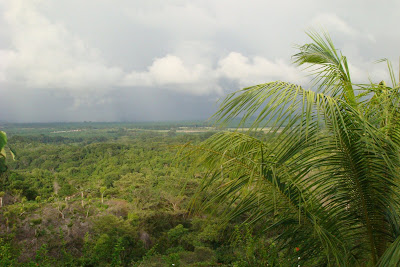 |
| From Costa Rica Oct 08 |
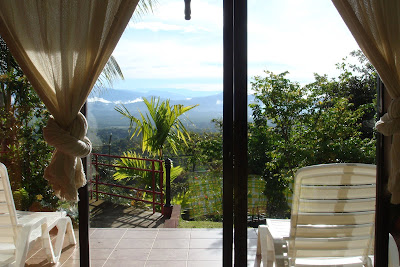 |
| From Costa Rica Oct 08 |
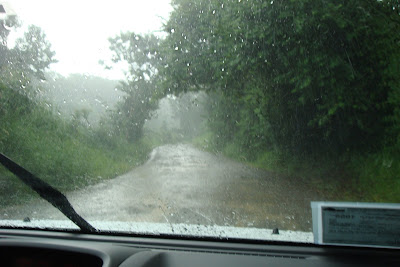 |
| From Costa Rica Oct 08 |
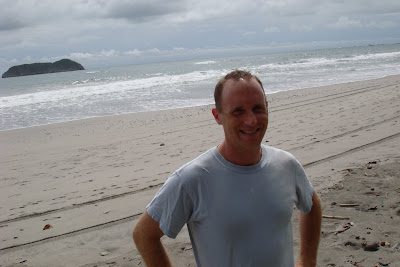 |
| From Costa Rica Oct 08 |
 |
| From Costa Rica Oct 08 |
Wednesday, September 24, 2008
Anaphylactic Paraparesis
or Skyline-to-the-Bees
Join us on another exciting adventure with our fearless duo as they attempt to descend from the heights of the Skyline (or, at least, a parking at a whopping 2600ft elevation) to the depths of the very sea (aka a plot of grass across the highway from the beach). Will they be up for the challenges that lay ahead of them? Will they be able to pound the steep, downhill trails without their quads exploding? Will they survive the onslaught of hoards of angry wasps? Traverse rocks and hidden tree roots? Navigate deceptive uphills nestled amongst a net-downhill course? Our ever-accelerating Rocky "the flying squirrel" should be able to literally soar unstoppably down this path as he leads the front of the race. But, what of our beloved though befuddled moose? Will the venerable “mid-pack plodder” be able to complete the distance sans allergic reaction and seizing limbs, or will he be shamed into returning to his previous vocation (and avocation) of conveniently storing head wear amongst his cranial projections? Tune in to our next episode to find out.
Cast:
Rocket J. Squirrel - Lon Freeman (Leor Pantilat understudy)
Bullwinkle Moose - Steve Ansell
Boris Badenov - Wendell Doman
Natasha Fatale - Sarah Spelt
Fearless Leader - Aaron Doman (yes, he is really the one behind the scenes)
Gidney & Cloyd - Beat J and Harry Walther (Explorers from the Moon)
Dudley Do-Right - Craig Slagel
Snidley Whiplash - Fred Ecks
"Hey Rocky, watch me pull a Yellowjacket out of my....OOWWW...&@$%*$!!!!!"
------
OK, I think I just expended my limited reserve of creative juices on the intro. I guess I'll have to proceed with a mundane report of the actual race.
I'd been looking forward to the Skyline-to-the-Sea (aka SttS) for some time. I've always wanted to run this entire trail that goes from Skyline Blvd up above the city of Saratoga and finishes at the Pacific Ocean near Waddell Beach. In fact, I was one of the people encouraging Sarah and Wendell with great enthusiasm to add this event to their already crowded calendar (sorry Aaron). Not only is this a classic Bay Area hiking and backpacking trail, but it is a downhill course that seemed like it would play to my strengths. I even ran a preview of the top part of the course a couple of weeks ago. It was almost as if I was planning to treat this like a "real race" or something. After the preview, I had pretty much run every bit of this trail at one point or another at some point in the past. I ran the bottom part up from the beach to Big Basin Headquarters a couple of years ago when preparing for the Big Basin 50K. I ran the section down to Berry Creek both times I did that race. The last part from China Grade down, I didn't know I had been on until race day. It seemed very familiar and I now think it was part of the Big Basin Trail Half Marathon that I ran about 5 years ago.
Because this was a point-to-point course, there was a shuttle bus arranged that started from the finish and took us to the start. This also meant that I had to be at the shuttle area just south of Santa Cruz before 6:30am. And this meant that I had to get my sorry butt out of bed at 4-something A.M. in the morning. I'm really not a morning person. Somehow I managed to wake myself up enough to drive to the bus location without incident. Since this was a 50K only event for PCTR, it was all ultrarunners and so a lot of familiar faces. I was surprised that many people were actually able to go back to sleep on the bus especially with people like me and Craig blabbing on and on as we did. But, it was fun catching up with everyone during the 45 minute ride to the start.
After more catching up and milling about, Wendell gathered everyone at the start of the trail. He called for all the fast runners to line up in the front. The early miles consist of a lot of rolling singletrack so in order to try and avoid a messy bottleneck or lots of passing on tight trails, he was attempting to put people into some semblance of order. He then called for people who planned to finish in the 5-hour range. Now, I've only dipped below 5 hours once and that was on a 50K course that was pretty much a flat, road run. However, I knew that with a good deal of downhill early in this race I was going to have to hang with a lot of faster runners early on. If the trail had a nice big straight-shot downhill from the get go, it would not have been a problem. However, the initial few downhill miles didn't quite allow for an all-out, "let it fly" approach. They more wind around through the woods, crossing the road a few times and rolling up quite a few times on the way down.
While the broad view of the profile might make it look like a straight drop...

...a close examination of some of those initial steep sections shows quite a bit of up-and-down interspersed throughout.

For me, this meant that I had to push a lot more than I normally would. It was either that, or I would have been exchanging places with some people over and over on each up and down bit of trail. I tried to keep it reasonable, monitoring my breathing and reminding myself that most of these people would be leaving me as soon as we came to the first major uphill towards China Grade. My plan was just to push to that initial extended up hill section and then take it easy on the climb.
Craig Slagel stuck with me as did a guy named Franz whom I knew from the Runner's World Forums as "pure_h2o". We were only a little ways into the race when I heard the yells behind me. Apparently, the famous Big Basin Wasps were already out and ready to make sure we remember that we are mere interlopers in their park. I missed the first batch which I figured would probably fuel further rumors that I am the one who lures them to the runners in the first place. However, a little ways after the first aid station a lone yellow jacket caught up with me and nailed me in the arm. Not too bad. Nothing like my 20+ stings from the Big Basin 50K last year. Well, nothing like it yet, anyway.
We were having a good day despite the initial attack and I definitely enjoyed the downhill. But, all good things must end and the first long hill was upon us. I took it easy, but still maintained a shuffle pace as most of the uphill is fairly gradual. As expected, I was passed by many as we made our way to the second aid station. I went in and out quickly as I knew there would be another downhill section coming up. We headed over the rocky bit that I recognized from the Big Basin Half Marathon when it hit us, The Swarm! I felt the first one on the back of my head, then my back, then my neck and shoulders. It was probably even worse for Craig and Franz as they could see the mass of the little buggers as they got me, but there was nothing they could do to avoid them. It was just run screaming down the trail, waving arms and spraying oneself with water. Once we were out of immediate danger, we all stopped to inspect one another and remove any hangers-on. I know I got at least 1/2 a dozen stings, but what could be done? Deal with it an move on thankful that I didn't inherit my mothers allergies.
I know Sarah and Wendell always dread holding these races during heavy wasp season as I can't imagine anything worse for and RD than the thought of someone having a severe allergic reaction out on a remote section of trail. The three of us stuck together and tried to get back into a good rhythm. The other thing that an attack like that does is to totally throw off your heart rate and drain an awful lot of mental energy. I know the rest of the downhill section was run a bit more cautiously than normal mainly due to a simple lack of focus. For some reason, the ones in the head always feel like I'd been knocked with some sort of blunt instrument.
I tried to just focus on enjoying the trail and the beauty of running through the woods. We came to the section just before the Gazos Creek where the trail leveled a bit. I knew this trail and that it would go through some rolling terrain before we acquired the aid station. I was focusing on keeping a good pace over the varied terrain when I head "on your left" a little ways behind me. I thought that maybe someone in our little group had decided to pick it up when the voice came too soon right behind me. I barely had time to move to the side when Lon Freman flew by me at a pace that I would probably be proud of in a 5K race let alone a 50K. I figured that he was way out in front, but I didn't know that there was another runner whom he was reeling in. "How the heck do you get lapped in a point to point race?" I joked. Of course, I knew the answer as the section of the course we were on would be repeated as we did the only loop of this race.
The loop included the steepest uphill section of the course right after the aid station. I took it easy here, maybe even a little too easy as it is all runnable. We were past the half way point and if I was serious about racing, this is where I should have pushed myself. But, I'm never really that serious. This is also the section where Craig and I expected Fred to catch up with his superior climbing abilities. However, we didn't see him and I was happy when we hit the downhill again. Franz went ahead of Craig and I on the last uphill and then proceded to charge the downs. I gave chase, but he did a fabulous job of staving me off. I was recharged a bit and ready to push the final bit, but I knew there was one more uphill before my favorite part of the trail.
In and out of the aid station I went and then proceded across the road to the trail that would be the longest section without aid. I, again took it very easy on the uphills, walking quite a bit here. Craig caught up with me and we chatted a bit before a familar voice called from below us on the trail. Fred!
"Dude, what took you so long? We expected you to catch us on the Gazos loop."
It didn't matter, Fred had caught us now and marched right past on the next uphill. I tried to let him drag me up, but I couldn't match his hiking pace and I didn't want to go into a run, saving myself for the long downhill to come. I knew if I kept him in sights I would probably catch him somewhere up ahead.
Finally, I crested the ridge and I took a short breather anticipating a crushing downhill for the next few miles as it descends, twists and winds on technical single-track. I started down and immediately had to pull up. A shot of pain through my right knee. It wasn't a jarring sort, but more like a feeling of over-extending the leg. I stretched and massaged, watching up trail for anyone coming down behind me. I took off again, but more gingerly this time. My knee kept wanting to lock. I knew it was something that would likely work itself out, but I couldn't let myself go when it is, so, what I wanted to do. I put up with it and just let it work itself out. Eventually, I was able to run in my normal manner and had fun jumping over roots and rocks on the bottom part of the trail. I caught Fred and bid him farewell just before reaching Berry Creek. I was not necessarily looking forward to the final miles on the gradually sloping fire road, but I did want to test my recent speed work and see if I could push myself to the finish.
I continued pushing. This is the part where experience pays off. I passed a number of people during this next section. Some who had gone out too fast in the early miles, some who didn't have the quads for all this downhill and a few who just made logistical mistakes (no water bottle for an 8+ mile section of trail with more than 20 under you belt?) I caught up with Franz and hung with him for a little while, but he looked to have spent his legs already. Just as I left him, and just as I was mentally patting myself on the back, I did it. As usually, on a relatively tame section of trail, I let my mind wander and caught my foot on some little rock sticking up from the dirt. Somehow I managed to just take it in stride performing what Franz would later describe as a "perfect Aikido roll" before landing right back on my feet and not loosing stride.
In fact, after checking the pain in my left knee, I think the adrenaline that kicked in after my little spill drove me to push even harder. The last part of this course only drops about 300ft in the final 5 miles and much of those miles includes more than a few little uphill bits to assure that a final effort is needed to meet any time goals. I had pretty much given up on a sub-5 hour finish as I didn't think I could make up the time needed for it. However, I am always doing mental math as I run the final miles of a race and so I thought that breaking 5:10 seemed like a good goal. That is basically a sub-10 minute mile for the 50K. I tried hard to stay under 9s on the down slopes and not to break too much above 10 on the uphill sections. I also was contending with making my hydration last as the day had gotten pretty warm and this was a long stint without aid.
Running with two empty water bottles in my hands, the final aid station came into sight. I didn't know quite how far it was to the finish, but I simply wanted to be in, out and on my way at this point. Before I could even make out who it was, the taunts came down the trail at me.
"Is that Steve?"
" No aid for you, buddy. Just keep going!"
While I'm not sure that abuse was exactly what I needed at this point, I knew these two jokers wouldn't let me linger any longer than necessary. In fact, I had barely sucked down a Coke when Beat was literally kicking me in the rear to get a move on. It turned out to be only a couple of miles to the finish. I was happy to learn it was muchless than I expected.
I knew these last couple of miles woudl be long. I remembered running them during a training run. It would be hot and exposed. To make matters a little worse, Wendell had to alter the course a bit. Instead of heading all the way to the beach and then back to the finish, we would around on some meandering trails over footbridges and through hedges that seemed to go on and on. I could hear the finish line chatter somewhere in the distance, but could not tell how far off it was. The clock was ticking, I was pushing, 5:10 was approaching. Finally, one last turn to the left and the inevitable sprint to the finish.
5:09:32
A respectible time for a "mid-pack, plodder" and 30th overall putting me well in my goal top-1/3 with 178 finishers in the final talley. However, I still wonder if I could find 10 minutes out there on the course somewhere. In the end, the fact remains that on a course that played well to my strengths, the only way to really improve is to work on my weaknesses. Those obnoxious uphills in the midst of this "mostly downhill" race, are where lost minutes are to be found.
Join us on another exciting adventure with our fearless duo as they attempt to descend from the heights of the Skyline (or, at least, a parking at a whopping 2600ft elevation) to the depths of the very sea (aka a plot of grass across the highway from the beach). Will they be up for the challenges that lay ahead of them? Will they be able to pound the steep, downhill trails without their quads exploding? Will they survive the onslaught of hoards of angry wasps? Traverse rocks and hidden tree roots? Navigate deceptive uphills nestled amongst a net-downhill course? Our ever-accelerating Rocky "the flying squirrel" should be able to literally soar unstoppably down this path as he leads the front of the race. But, what of our beloved though befuddled moose? Will the venerable “mid-pack plodder” be able to complete the distance sans allergic reaction and seizing limbs, or will he be shamed into returning to his previous vocation (and avocation) of conveniently storing head wear amongst his cranial projections? Tune in to our next episode to find out.
Cast:
Rocket J. Squirrel - Lon Freeman (Leor Pantilat understudy)
Bullwinkle Moose - Steve Ansell
Boris Badenov - Wendell Doman
Natasha Fatale - Sarah Spelt
Fearless Leader - Aaron Doman (yes, he is really the one behind the scenes)
Gidney & Cloyd - Beat J and Harry Walther (Explorers from the Moon)
Dudley Do-Right - Craig Slagel
Snidley Whiplash - Fred Ecks
"Hey Rocky, watch me pull a Yellowjacket out of my....OOWWW...&@$%*$!!!!!"
------
OK, I think I just expended my limited reserve of creative juices on the intro. I guess I'll have to proceed with a mundane report of the actual race.
I'd been looking forward to the Skyline-to-the-Sea (aka SttS) for some time. I've always wanted to run this entire trail that goes from Skyline Blvd up above the city of Saratoga and finishes at the Pacific Ocean near Waddell Beach. In fact, I was one of the people encouraging Sarah and Wendell with great enthusiasm to add this event to their already crowded calendar (sorry Aaron). Not only is this a classic Bay Area hiking and backpacking trail, but it is a downhill course that seemed like it would play to my strengths. I even ran a preview of the top part of the course a couple of weeks ago. It was almost as if I was planning to treat this like a "real race" or something. After the preview, I had pretty much run every bit of this trail at one point or another at some point in the past. I ran the bottom part up from the beach to Big Basin Headquarters a couple of years ago when preparing for the Big Basin 50K. I ran the section down to Berry Creek both times I did that race. The last part from China Grade down, I didn't know I had been on until race day. It seemed very familiar and I now think it was part of the Big Basin Trail Half Marathon that I ran about 5 years ago.
Because this was a point-to-point course, there was a shuttle bus arranged that started from the finish and took us to the start. This also meant that I had to be at the shuttle area just south of Santa Cruz before 6:30am. And this meant that I had to get my sorry butt out of bed at 4-something A.M. in the morning. I'm really not a morning person. Somehow I managed to wake myself up enough to drive to the bus location without incident. Since this was a 50K only event for PCTR, it was all ultrarunners and so a lot of familiar faces. I was surprised that many people were actually able to go back to sleep on the bus especially with people like me and Craig blabbing on and on as we did. But, it was fun catching up with everyone during the 45 minute ride to the start.
After more catching up and milling about, Wendell gathered everyone at the start of the trail. He called for all the fast runners to line up in the front. The early miles consist of a lot of rolling singletrack so in order to try and avoid a messy bottleneck or lots of passing on tight trails, he was attempting to put people into some semblance of order. He then called for people who planned to finish in the 5-hour range. Now, I've only dipped below 5 hours once and that was on a 50K course that was pretty much a flat, road run. However, I knew that with a good deal of downhill early in this race I was going to have to hang with a lot of faster runners early on. If the trail had a nice big straight-shot downhill from the get go, it would not have been a problem. However, the initial few downhill miles didn't quite allow for an all-out, "let it fly" approach. They more wind around through the woods, crossing the road a few times and rolling up quite a few times on the way down.
While the broad view of the profile might make it look like a straight drop...

...a close examination of some of those initial steep sections shows quite a bit of up-and-down interspersed throughout.

For me, this meant that I had to push a lot more than I normally would. It was either that, or I would have been exchanging places with some people over and over on each up and down bit of trail. I tried to keep it reasonable, monitoring my breathing and reminding myself that most of these people would be leaving me as soon as we came to the first major uphill towards China Grade. My plan was just to push to that initial extended up hill section and then take it easy on the climb.
Craig Slagel stuck with me as did a guy named Franz whom I knew from the Runner's World Forums as "pure_h2o". We were only a little ways into the race when I heard the yells behind me. Apparently, the famous Big Basin Wasps were already out and ready to make sure we remember that we are mere interlopers in their park. I missed the first batch which I figured would probably fuel further rumors that I am the one who lures them to the runners in the first place. However, a little ways after the first aid station a lone yellow jacket caught up with me and nailed me in the arm. Not too bad. Nothing like my 20+ stings from the Big Basin 50K last year. Well, nothing like it yet, anyway.
We were having a good day despite the initial attack and I definitely enjoyed the downhill. But, all good things must end and the first long hill was upon us. I took it easy, but still maintained a shuffle pace as most of the uphill is fairly gradual. As expected, I was passed by many as we made our way to the second aid station. I went in and out quickly as I knew there would be another downhill section coming up. We headed over the rocky bit that I recognized from the Big Basin Half Marathon when it hit us, The Swarm! I felt the first one on the back of my head, then my back, then my neck and shoulders. It was probably even worse for Craig and Franz as they could see the mass of the little buggers as they got me, but there was nothing they could do to avoid them. It was just run screaming down the trail, waving arms and spraying oneself with water. Once we were out of immediate danger, we all stopped to inspect one another and remove any hangers-on. I know I got at least 1/2 a dozen stings, but what could be done? Deal with it an move on thankful that I didn't inherit my mothers allergies.
I know Sarah and Wendell always dread holding these races during heavy wasp season as I can't imagine anything worse for and RD than the thought of someone having a severe allergic reaction out on a remote section of trail. The three of us stuck together and tried to get back into a good rhythm. The other thing that an attack like that does is to totally throw off your heart rate and drain an awful lot of mental energy. I know the rest of the downhill section was run a bit more cautiously than normal mainly due to a simple lack of focus. For some reason, the ones in the head always feel like I'd been knocked with some sort of blunt instrument.
I tried to just focus on enjoying the trail and the beauty of running through the woods. We came to the section just before the Gazos Creek where the trail leveled a bit. I knew this trail and that it would go through some rolling terrain before we acquired the aid station. I was focusing on keeping a good pace over the varied terrain when I head "on your left" a little ways behind me. I thought that maybe someone in our little group had decided to pick it up when the voice came too soon right behind me. I barely had time to move to the side when Lon Freman flew by me at a pace that I would probably be proud of in a 5K race let alone a 50K. I figured that he was way out in front, but I didn't know that there was another runner whom he was reeling in. "How the heck do you get lapped in a point to point race?" I joked. Of course, I knew the answer as the section of the course we were on would be repeated as we did the only loop of this race.
The loop included the steepest uphill section of the course right after the aid station. I took it easy here, maybe even a little too easy as it is all runnable. We were past the half way point and if I was serious about racing, this is where I should have pushed myself. But, I'm never really that serious. This is also the section where Craig and I expected Fred to catch up with his superior climbing abilities. However, we didn't see him and I was happy when we hit the downhill again. Franz went ahead of Craig and I on the last uphill and then proceded to charge the downs. I gave chase, but he did a fabulous job of staving me off. I was recharged a bit and ready to push the final bit, but I knew there was one more uphill before my favorite part of the trail.
In and out of the aid station I went and then proceded across the road to the trail that would be the longest section without aid. I, again took it very easy on the uphills, walking quite a bit here. Craig caught up with me and we chatted a bit before a familar voice called from below us on the trail. Fred!
"Dude, what took you so long? We expected you to catch us on the Gazos loop."
It didn't matter, Fred had caught us now and marched right past on the next uphill. I tried to let him drag me up, but I couldn't match his hiking pace and I didn't want to go into a run, saving myself for the long downhill to come. I knew if I kept him in sights I would probably catch him somewhere up ahead.
Finally, I crested the ridge and I took a short breather anticipating a crushing downhill for the next few miles as it descends, twists and winds on technical single-track. I started down and immediately had to pull up. A shot of pain through my right knee. It wasn't a jarring sort, but more like a feeling of over-extending the leg. I stretched and massaged, watching up trail for anyone coming down behind me. I took off again, but more gingerly this time. My knee kept wanting to lock. I knew it was something that would likely work itself out, but I couldn't let myself go when it is, so, what I wanted to do. I put up with it and just let it work itself out. Eventually, I was able to run in my normal manner and had fun jumping over roots and rocks on the bottom part of the trail. I caught Fred and bid him farewell just before reaching Berry Creek. I was not necessarily looking forward to the final miles on the gradually sloping fire road, but I did want to test my recent speed work and see if I could push myself to the finish.
I continued pushing. This is the part where experience pays off. I passed a number of people during this next section. Some who had gone out too fast in the early miles, some who didn't have the quads for all this downhill and a few who just made logistical mistakes (no water bottle for an 8+ mile section of trail with more than 20 under you belt?) I caught up with Franz and hung with him for a little while, but he looked to have spent his legs already. Just as I left him, and just as I was mentally patting myself on the back, I did it. As usually, on a relatively tame section of trail, I let my mind wander and caught my foot on some little rock sticking up from the dirt. Somehow I managed to just take it in stride performing what Franz would later describe as a "perfect Aikido roll" before landing right back on my feet and not loosing stride.
In fact, after checking the pain in my left knee, I think the adrenaline that kicked in after my little spill drove me to push even harder. The last part of this course only drops about 300ft in the final 5 miles and much of those miles includes more than a few little uphill bits to assure that a final effort is needed to meet any time goals. I had pretty much given up on a sub-5 hour finish as I didn't think I could make up the time needed for it. However, I am always doing mental math as I run the final miles of a race and so I thought that breaking 5:10 seemed like a good goal. That is basically a sub-10 minute mile for the 50K. I tried hard to stay under 9s on the down slopes and not to break too much above 10 on the uphill sections. I also was contending with making my hydration last as the day had gotten pretty warm and this was a long stint without aid.
Running with two empty water bottles in my hands, the final aid station came into sight. I didn't know quite how far it was to the finish, but I simply wanted to be in, out and on my way at this point. Before I could even make out who it was, the taunts came down the trail at me.
"Is that Steve?"
" No aid for you, buddy. Just keep going!"
While I'm not sure that abuse was exactly what I needed at this point, I knew these two jokers wouldn't let me linger any longer than necessary. In fact, I had barely sucked down a Coke when Beat was literally kicking me in the rear to get a move on. It turned out to be only a couple of miles to the finish. I was happy to learn it was muchless than I expected.
I knew these last couple of miles woudl be long. I remembered running them during a training run. It would be hot and exposed. To make matters a little worse, Wendell had to alter the course a bit. Instead of heading all the way to the beach and then back to the finish, we would around on some meandering trails over footbridges and through hedges that seemed to go on and on. I could hear the finish line chatter somewhere in the distance, but could not tell how far off it was. The clock was ticking, I was pushing, 5:10 was approaching. Finally, one last turn to the left and the inevitable sprint to the finish.
5:09:32
A respectible time for a "mid-pack, plodder" and 30th overall putting me well in my goal top-1/3 with 178 finishers in the final talley. However, I still wonder if I could find 10 minutes out there on the course somewhere. In the end, the fact remains that on a course that played well to my strengths, the only way to really improve is to work on my weaknesses. Those obnoxious uphills in the midst of this "mostly downhill" race, are where lost minutes are to be found.
Sunday, September 21, 2008
Catching up
Attempting to get up to date on running things after my typical blogging ennui that seems to follow my 100 mile races. I have generally returned to normal running within a week or so after my big races, but I seem to take longer and longer to arrive at the point where I can sort it all out in my brain and report about it. Perhaps I will analyze and write about that at some point. Then again, maybe it's as simple as the fact that finishing each of these races is a very personal experience and it is hard to figure out what and how to share.
As previously reported, the week after Cascade was focused on my wife's race at Disneyland. We did a few short runs the week leading up to the race. The following week, I returned to my running schedule in earnest. I've set a goal for myself at my next hundred, Javelina. Last year, I had a sub-24 hour finish and this year I've decided to try and take it down even further. I will write more on this later. The initial implication of this goal is that, I have decided to add weekly speed work into my schedule. The idea is that training my body to become accustom to some faster running at least once a week will make all my slower running seem easier as well as allow me to tap into a slightly faster pace late in a long race. I'm starting with intervals since I've read that they are better than simple tempo runs. I like 1/2-mile repeats with 1/4-mile jogs between. My goal is to build to 8-10 repeats per week. I may do some variations once I have been doing it for a while, but the most important thing is to be consistent in doing some "work" once a week.
Unfortunately, my first week of speed work coincided with a local heat wave that saw temps hit triple digits. Mid-day repeats plus appresive heat minus a water bottle equals a redlined heart rate and more than a fraction of pain. I only managed 4 repeats before I realized what a stupid idea this was. I did two more 1/4-mile repeats followed by an extended cool down that still left me far from cool. Not quite as I planned, but I have managed a bit better in the following two weeks. The second week of intervals I managed 7 repeats. I targetted sub-7 minute miles as a starting point. I managed to stay close to that even when running into a strong headwind and managed my last tailwind repeat at a 6:43 pace. This past week I did what felt like my first "real" speed workout. I managed to keep all but my second (windy) repeat under a 7 mpm pace and dropped things down the more I did. On my 7th repeat, I pushed it down near a 6:40 pace and kept going for a full mile finishing in 6:45. I felt so good after that, I knocked off one final 1/2 for a total of 9. Now, 7-minute miles may not constitude speed work for many people (anyone who runs around a 3-hour or faster marathon, for instance), but for me it's about what my 5K pace was last time I ran a 5K. I imagine that I am a bit faster now, but I do have a pretty active imagination.
Aside from the speedwork, I have been trying to get my weekly mileage back into the 60+ mile range. I managed 62.5 miles the week after Disney doing a couple of runs on each of Saturday and Sunday. Sunday included a 24 miler along the top part of the Skyline-to-the-Sea trail. I hadn't run this section of the trail before and wanted to see what the race a couple of weeks later would be like at the start. While the course is a net downhill, there was quite a bit of rolling terrain at the start so I would have to think about what that would mean for a downhill "purist" such as myself come race day. The heatwave was ended, but not over and the run turned out to be pretty hot and a bit humid in the shaded woods. I ended up dehydrating myself pretty badly due to bad planning and a couple of bonus miles, but still had a good run. This race was one I was definitely looking forward to. I haven't "raced" a 50K in a while and wanted to see what I could do on this course. I didn't plan to taper or anything like that, but I did want to at least push it a bit.
The next week I managed nearly 67 miles mostly due to my friend Craig's 36-mile birthday run. My wife left for Singapore on Friday so I had pretty much no time constraints so it was going to be a full day of running with friends, something I almost never do outside of a race venue. There were six of us at the start including myself, Craig Slagel (the birthday boy), Fred Ecks, Chuck Wilson, Stephen Sorrow and Craig's girlfriend Mira who would be our roving aid station and support crew. We started at Muir Beach and generally followed the Headlands Hundred course up to Pantol. We then headed on to the top of Mt. Tam for the first loop and back for the first loop. Chuck wasn't up for the full 36 so he headed down via the Heather Cutoff trail that Headlands takes while we retraced our route up. This came to around 19 miles. For the second part we were going to go back up the same way and then just do an out-and-back towards Bolinas Ridge, but we decided to alter it a little bit. We went up the Heather Cutoff on the way out and came back down via our original route. We had a great time, in fact, almost too much fun in the beginning as our pace put our plan of making it back in time for the Sunday buffet at Pelican Inn out of reach. We picked it up a little for the second part, but still finished between 81/2 and 9 hours for the group. We all had a good time both during the run as well as at dinner afterwards.
My commented slideshow of the event can be viewed below for the interested.
As previously reported, the week after Cascade was focused on my wife's race at Disneyland. We did a few short runs the week leading up to the race. The following week, I returned to my running schedule in earnest. I've set a goal for myself at my next hundred, Javelina. Last year, I had a sub-24 hour finish and this year I've decided to try and take it down even further. I will write more on this later. The initial implication of this goal is that, I have decided to add weekly speed work into my schedule. The idea is that training my body to become accustom to some faster running at least once a week will make all my slower running seem easier as well as allow me to tap into a slightly faster pace late in a long race. I'm starting with intervals since I've read that they are better than simple tempo runs. I like 1/2-mile repeats with 1/4-mile jogs between. My goal is to build to 8-10 repeats per week. I may do some variations once I have been doing it for a while, but the most important thing is to be consistent in doing some "work" once a week.
Unfortunately, my first week of speed work coincided with a local heat wave that saw temps hit triple digits. Mid-day repeats plus appresive heat minus a water bottle equals a redlined heart rate and more than a fraction of pain. I only managed 4 repeats before I realized what a stupid idea this was. I did two more 1/4-mile repeats followed by an extended cool down that still left me far from cool. Not quite as I planned, but I have managed a bit better in the following two weeks. The second week of intervals I managed 7 repeats. I targetted sub-7 minute miles as a starting point. I managed to stay close to that even when running into a strong headwind and managed my last tailwind repeat at a 6:43 pace. This past week I did what felt like my first "real" speed workout. I managed to keep all but my second (windy) repeat under a 7 mpm pace and dropped things down the more I did. On my 7th repeat, I pushed it down near a 6:40 pace and kept going for a full mile finishing in 6:45. I felt so good after that, I knocked off one final 1/2 for a total of 9. Now, 7-minute miles may not constitude speed work for many people (anyone who runs around a 3-hour or faster marathon, for instance), but for me it's about what my 5K pace was last time I ran a 5K. I imagine that I am a bit faster now, but I do have a pretty active imagination.
Aside from the speedwork, I have been trying to get my weekly mileage back into the 60+ mile range. I managed 62.5 miles the week after Disney doing a couple of runs on each of Saturday and Sunday. Sunday included a 24 miler along the top part of the Skyline-to-the-Sea trail. I hadn't run this section of the trail before and wanted to see what the race a couple of weeks later would be like at the start. While the course is a net downhill, there was quite a bit of rolling terrain at the start so I would have to think about what that would mean for a downhill "purist" such as myself come race day. The heatwave was ended, but not over and the run turned out to be pretty hot and a bit humid in the shaded woods. I ended up dehydrating myself pretty badly due to bad planning and a couple of bonus miles, but still had a good run. This race was one I was definitely looking forward to. I haven't "raced" a 50K in a while and wanted to see what I could do on this course. I didn't plan to taper or anything like that, but I did want to at least push it a bit.
The next week I managed nearly 67 miles mostly due to my friend Craig's 36-mile birthday run. My wife left for Singapore on Friday so I had pretty much no time constraints so it was going to be a full day of running with friends, something I almost never do outside of a race venue. There were six of us at the start including myself, Craig Slagel (the birthday boy), Fred Ecks, Chuck Wilson, Stephen Sorrow and Craig's girlfriend Mira who would be our roving aid station and support crew. We started at Muir Beach and generally followed the Headlands Hundred course up to Pantol. We then headed on to the top of Mt. Tam for the first loop and back for the first loop. Chuck wasn't up for the full 36 so he headed down via the Heather Cutoff trail that Headlands takes while we retraced our route up. This came to around 19 miles. For the second part we were going to go back up the same way and then just do an out-and-back towards Bolinas Ridge, but we decided to alter it a little bit. We went up the Heather Cutoff on the way out and came back down via our original route. We had a great time, in fact, almost too much fun in the beginning as our pace put our plan of making it back in time for the Sunday buffet at Pelican Inn out of reach. We picked it up a little for the second part, but still finished between 81/2 and 9 hours for the group. We all had a good time both during the run as well as at dinner afterwards.
My commented slideshow of the event can be viewed below for the interested.
Did we land? At Disneyland!
By necessity I do much of my mid-weak training on roads, but I have never been much of a road runner. My one and only road marathon was about 3 1/2 years ago. My one and only road 1/2 marathon was almost 7 years ago. But, when my wife agreed to train for a marathon, enticed by the lure of amusement parks and people dressed as giant cartoon characters, I was more than happy to hit the roads. Keeping with the Disney theme, the first stop along the path to Orlando was the Disneyland 1/2 Marathon during Labor Day weekend. So, the week after Cascade Crest, I was back on a plane headed in the opposite direction for my wife's race and my recovery run. That and a whole lot of fun.
The really short summary of the weekend is that my wife did awesome and we had a really fun time. If you are going to do a road race, it might as well be in a unique and entertaining venue. The course winds through both the Disney's California Adventure Park as well as Disneyland proper. It then takes a less entertaining trip through the streets of Anaheim going out and around Angel's Stadium before returning and finishing through Downtown Disney.
No mountain vistas, no winding forest paths, in fact, no real trails of any kind. Just my wife and I running around enjoying the "Happiest Race on Earth." So, if your not one for big crowded road races or you just don't like amusement parks, this is not for you. But, if you can appreciate a trip on Space Mountain as well as a trip to the mountains, then enjoy the pictures and report below.
Our hotel was close enough to the start of the race that we could just walk there in the dark hours of the morning. It was hard to figure out which exact group you were supposed to line up in, but certainly not hard to find some place to be. We were supposed to be in last group since Zane had never run a the distance, but we landed in the middle group which ended up being pretty much exactly where we finished the race.
Here we are at the start waiting for the start...
...with a bit more than 10,000 other people.
Some people chose to wear costumes including this couple who both dressed as my wife's favorite Disney character, Tinker Bell. They were actually near us for much of the race. They were a lot of fun and I came to think of them as "The Tinks."
Eventually, the race began with a bit more fanfare than most trail races and we all moved forward.
After about a mile circling on the roads, we headed into the California Adventure park.
I stopped to take a lot of pictures most of which were pretty blurry like this one
We then headed over to Disneyland.
We, of course, had to stop for a photo op with Peter Pan and Tinker Bell
Lot's of other characters were around cheering us on as well
But, there's only so much running you can do around the parks so we eventually headed back out onto the roads.
The typical road race bands and cheer squads lined the course.
But, The Tinks were on hand to keep the Disney theme. Of course, the downside of this is that my wife is now scheming some sort of idea for next year.
Then more dance squads, cute little hula girls and other such groups to distract us from the more mundane scenery of office parks.
But, the Disney theme still there.
There was a little bit of "trail" along the canal.
Then it was on to stadium.
Then, it was finally time to head back for the last couple of miles.
My wife said that mile 11 on were tough. We found a great bracelet that I bought for her at the Expo the day before that helped get here through this section. It read "Tough Times Don't Last, but Tough People Do." She said she looked down at it about a dozen times in those last miles. I can't exactly wear the bracelet, but I will certainly remember the saying the next time I need it in an ultra.
Then, we were back into the Disney area.
The final stretch through Downtown Disney seemed a little longer than when we strolled down it the day before.
But, the finish line came into view and Zane kicked it in to finish in just below 2:30. An awesome, awesome job.
We made our way back to the hotel shuttle.
But, as we sat there with our post race goodies (which included yummy little mini pies), we eventually realized that the shuttle wasn't coming and we had to walk back to the hotel, but that didn't stop the smiles.
After some food and rest, we spent the rest of the day having fun riding rides and then went to dinner with the boys at the ESPN restaurant where we enjoyed eating from lounge chairs in front of giant screens showing about a dozen different sports.
The whole weekend was a lot of fun and I'm looking forward to adding the full marathon medal to this one.
The really short summary of the weekend is that my wife did awesome and we had a really fun time. If you are going to do a road race, it might as well be in a unique and entertaining venue. The course winds through both the Disney's California Adventure Park as well as Disneyland proper. It then takes a less entertaining trip through the streets of Anaheim going out and around Angel's Stadium before returning and finishing through Downtown Disney.
No mountain vistas, no winding forest paths, in fact, no real trails of any kind. Just my wife and I running around enjoying the "Happiest Race on Earth." So, if your not one for big crowded road races or you just don't like amusement parks, this is not for you. But, if you can appreciate a trip on Space Mountain as well as a trip to the mountains, then enjoy the pictures and report below.
Our hotel was close enough to the start of the race that we could just walk there in the dark hours of the morning. It was hard to figure out which exact group you were supposed to line up in, but certainly not hard to find some place to be. We were supposed to be in last group since Zane had never run a the distance, but we landed in the middle group which ended up being pretty much exactly where we finished the race.
Here we are at the start waiting for the start...
 |
| From Disneyland half |
...with a bit more than 10,000 other people.
 |
| From Disneyland half |
Some people chose to wear costumes including this couple who both dressed as my wife's favorite Disney character, Tinker Bell. They were actually near us for much of the race. They were a lot of fun and I came to think of them as "The Tinks."
 |
| From Disneyland half |
Eventually, the race began with a bit more fanfare than most trail races and we all moved forward.
 |
| From Disneyland half |
After about a mile circling on the roads, we headed into the California Adventure park.
 |
| From Disneyland half |
I stopped to take a lot of pictures most of which were pretty blurry like this one
 |
| From Disneyland half |
We then headed over to Disneyland.
 |
| From Disneyland half |
We, of course, had to stop for a photo op with Peter Pan and Tinker Bell
 |
| From Disneyland half |
Lot's of other characters were around cheering us on as well
 |
| From Disneyland half |
 |
| From Disneyland half |
But, there's only so much running you can do around the parks so we eventually headed back out onto the roads.
 |
| From Disneyland half |
The typical road race bands and cheer squads lined the course.
 |
| From Disneyland half |
But, The Tinks were on hand to keep the Disney theme. Of course, the downside of this is that my wife is now scheming some sort of idea for next year.
 |
| From Disneyland half |
Then more dance squads, cute little hula girls and other such groups to distract us from the more mundane scenery of office parks.
 |
| From Disneyland half |
 |
| From Disneyland half |
 |
| From Disneyland half |
But, the Disney theme still there.
 |
| From Disneyland half |
There was a little bit of "trail" along the canal.
 |
| From Disneyland half |
Then it was on to stadium.
 |
| From Disneyland half |
Then, it was finally time to head back for the last couple of miles.
 |
| From Disneyland half |
My wife said that mile 11 on were tough. We found a great bracelet that I bought for her at the Expo the day before that helped get here through this section. It read "Tough Times Don't Last, but Tough People Do." She said she looked down at it about a dozen times in those last miles. I can't exactly wear the bracelet, but I will certainly remember the saying the next time I need it in an ultra.
Then, we were back into the Disney area.
 |
| From Disneyland half |
The final stretch through Downtown Disney seemed a little longer than when we strolled down it the day before.
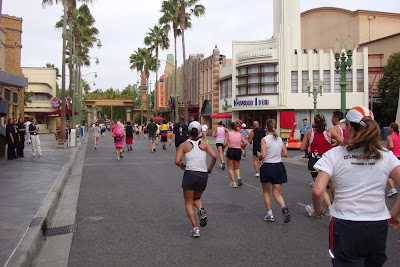 |
| From Disneyland half |
But, the finish line came into view and Zane kicked it in to finish in just below 2:30. An awesome, awesome job.
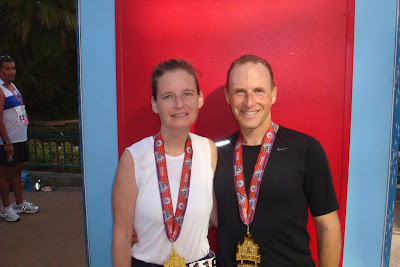 |
| From Disneyland half |
We made our way back to the hotel shuttle.
 |
| From Disneyland half |
But, as we sat there with our post race goodies (which included yummy little mini pies), we eventually realized that the shuttle wasn't coming and we had to walk back to the hotel, but that didn't stop the smiles.
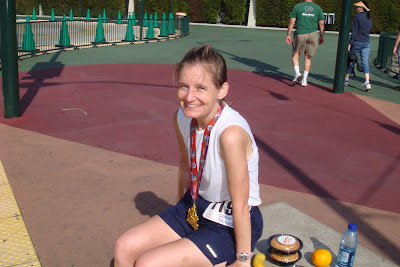 |
| From Disneyland half |
After some food and rest, we spent the rest of the day having fun riding rides and then went to dinner with the boys at the ESPN restaurant where we enjoyed eating from lounge chairs in front of giant screens showing about a dozen different sports.
The whole weekend was a lot of fun and I'm looking forward to adding the full marathon medal to this one.
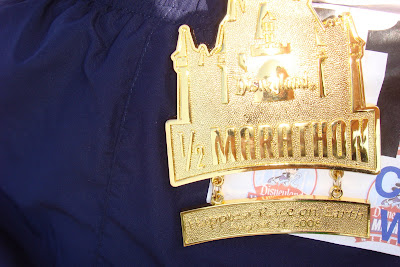 |
| From Disneyland half |
Tuesday, September 02, 2008
A Course is A Course of Course
Wow, am I behind on my race reports! I guess I've been hit with a strong dose of the post-100 ennui that Perhaps it will encourage me to essentialize and keep this brief.
What can I say about Cascade Crest? It is definitely a classic course. Every course seems to have its major unique challenge that identifies it whether its high altitude, super steep climbs, technical trails, hot canyons or unpredictable conditions. This course up in the Cascade Mountain Range in Washington state, seems to be an attempt by its course designers to try to fit in as many of the traditional trail challenges as they could while throwing in some of the most unique twists you will find anywhere. Even Hans-Dieter Weisshaar, who has run more than 100 100-milers, said that there are some parts of this course that are like nothing in any other 100 mile race.
To summarize, Cascade Crest includes the following:
I didn't really do a very good job of studying the course beforehand and maybe went into the race a little more nonchalant than I should for a 100 miler. However, I felt well trained and my only real goal was to redeem myself at this distance after my less than desirable finish at Bighorn. I did look at the maps and the profile a little bit and, somehow, figured that 27 hours seemed like a good goal for this race. I even put together a quick, "back-of-the-napkin" sort of plan. My simple idea was to run the first 1/3 of the race in 8 hours then have 19 remaining to run the other two thirds in something like 10 and 9 hours each (or vis-versa or some other similar combination). It wasn't a horrible plan and looking at the splits there is at least one person who came very close to splits like this and a couple who did much better in the last two thirds coming in under 26!
The thing is that if you look at the elevation profiles, it is clear that the bulk of the climbing, in terms of pure numbers, is in the first half of the race. So, even given the normal tendency to slow down by as much as 20% in the second half of a 100 miler, it seems possible to not loose so much time on this course, if you are just looking at it in the abstract. Except that things like trees, creeks, rocks and hills don't just exist "in the abstract." They exist in reality as real challenges to be faced and overcome and they don't really care how undaunting they may have appeared on a some computer-generated chart with alternating colored bars filling in the space beneath a squiggly line. If any course had to prove the assertion that "the overall elevation gain and loss doesn't tell the whole story," then Cascade Crest should be given the whiteboard marker and sent to the front of the class to school us all.
My plan was to go through my race now, section by section using the course profiles as a guide and posting the many pictures I took to give a sense of the place. However, at the rate I'm going I may never finish this thing and by the time I did I don't think anyone would want to read it. So, I am going to perform a complete cop-out and use modern technology as the crutch it was designed to be. So, in the place of witty banter, insightful observations and compelling narrative, I bring you a photo slide-show provided by the good folks at Google Picasa. This should provide all the entertainment, thrills and intellectual stimulation of back when my parents used to drag out the slide projector to show pictures of my butt-naked 3-year old self taking a bubble bath. Enjoy!
What can I say about Cascade Crest? It is definitely a classic course. Every course seems to have its major unique challenge that identifies it whether its high altitude, super steep climbs, technical trails, hot canyons or unpredictable conditions. This course up in the Cascade Mountain Range in Washington state, seems to be an attempt by its course designers to try to fit in as many of the traditional trail challenges as they could while throwing in some of the most unique twists you will find anywhere. Even Hans-Dieter Weisshaar, who has run more than 100 100-milers, said that there are some parts of this course that are like nothing in any other 100 mile race.
To summarize, Cascade Crest includes the following:
- Over 20,000ft +/- elevation change (enough to qualify it as one of the harder 100's alone)
- Some long slow uphill grinds (almost 3000ft right off the bat)
- Some short, but VERY steep climbs (late in the race, no less)
- Big wide fireroads
- Narrow single-track
- Rock-strewn trail
- Creek crossings
- Muddy sections
- Dozens of downed trees to climb over
- Downhill sections so over-groan you can't see your feet
- A little bit of snow on the ground for good measure
- Potentials for severe weather in either direction (we only had a little rain at the end)
I didn't really do a very good job of studying the course beforehand and maybe went into the race a little more nonchalant than I should for a 100 miler. However, I felt well trained and my only real goal was to redeem myself at this distance after my less than desirable finish at Bighorn. I did look at the maps and the profile a little bit and, somehow, figured that 27 hours seemed like a good goal for this race. I even put together a quick, "back-of-the-napkin" sort of plan. My simple idea was to run the first 1/3 of the race in 8 hours then have 19 remaining to run the other two thirds in something like 10 and 9 hours each (or vis-versa or some other similar combination). It wasn't a horrible plan and looking at the splits there is at least one person who came very close to splits like this and a couple who did much better in the last two thirds coming in under 26!
The thing is that if you look at the elevation profiles, it is clear that the bulk of the climbing, in terms of pure numbers, is in the first half of the race. So, even given the normal tendency to slow down by as much as 20% in the second half of a 100 miler, it seems possible to not loose so much time on this course, if you are just looking at it in the abstract. Except that things like trees, creeks, rocks and hills don't just exist "in the abstract." They exist in reality as real challenges to be faced and overcome and they don't really care how undaunting they may have appeared on a some computer-generated chart with alternating colored bars filling in the space beneath a squiggly line. If any course had to prove the assertion that "the overall elevation gain and loss doesn't tell the whole story," then Cascade Crest should be given the whiteboard marker and sent to the front of the class to school us all.
My plan was to go through my race now, section by section using the course profiles as a guide and posting the many pictures I took to give a sense of the place. However, at the rate I'm going I may never finish this thing and by the time I did I don't think anyone would want to read it. So, I am going to perform a complete cop-out and use modern technology as the crutch it was designed to be. So, in the place of witty banter, insightful observations and compelling narrative, I bring you a photo slide-show provided by the good folks at Google Picasa. This should provide all the entertainment, thrills and intellectual stimulation of back when my parents used to drag out the slide projector to show pictures of my butt-naked 3-year old self taking a bubble bath. Enjoy!
Subscribe to:
Posts (Atom)